
Seventy-one percent. That’s the share of Pakistani F-1 applicants who were refused a US student visa in 2025, according to a Shorelight analysis of US Department of State data reported by ICEF Monitor. Seven out of ten. Sitting with an I-20 from a good university, fees paid, bags half-packed.
So when you search for f1 visa interview questions 2026, you are not really looking for a list of questions. You are looking for the difference between the seven and the three.
That difference is rarely English. It is rarely grades. In the cases I’ve helped prepare from Lahore, Karachi and Islamabad, it is almost always one of three things: a story that doesn’t hold together, money that can’t be traced, or a plan for after graduation that sounds invented on the spot.
This guide gives you 45 real questions, grouped the way officers actually move through them. Under each one: a strong answer, a weak answer that gets refused, and what the officer is actually measuring. It also covers what changed in 2026 — because a rule published on 17 July 2026 has quietly made one old answer dangerous.
Quick Answer
US F-1 visa interviews at Islamabad and Karachi typically last two to four minutes and are decided under Section 214(b), which presumes every applicant intends to immigrate until proven otherwise. Pakistani students must pay a $185 MRV fee and a $350 SEVIS I-901 fee before interviewing, attend in person, and set all social media profiles to public.
Last verified: August 2026
What Changed for F-1 Applicants in 2026 (Read This Before You Rehearse Anything)
Four changes matter for anyone interviewing between now and the end of 2026. Two of them will get you refused if you answer using 2023-era advice.
1. “Duration of status” is being abolished on 15 September 2026
On 17 July 2026, DHS published a final rule titled Establishing a Fixed Time Period of Admission and an Extension of Stay Procedure for Nonimmigrant Academic Students, Exchange Visitors, and Representatives of Foreign Information Media (Federal Register). It takes effect 15 September 2026.
For decades, F-1 students were admitted for “D/S” — stay as long as you keep studying. That ends. Under the new rule, per DHS’s Study in the States quick facts:
- You are admitted for the program length on your Form I-20, capped at four years, plus 30 days to arrive and 30 days to depart.
- If your program runs longer, you file an extension of stay with USCIS or leave and re-enter.
- F-1 students who complete a degree after 15 September 2026 cannot start another US program at the same or a lower level. Finished a US master’s? You can’t enrol in a second US master’s.
- Undergraduates generally cannot change university, major or education level during their first academic year without SEVP approval.
Why this belongs in an interview guide: “I’ll do my master’s, then maybe another master’s, then see” was already a weak answer. In 2026 it describes something the regulations no longer permit. Litigation contesting the rule was in process as of early August 2026, so confirm status before you travel.
2. Your social media must be public — and officers search beyond it
Since 18 June 2025, the State Department has instructed all F, M and J applicants to set every social media profile to “public”. On 30 March 2026 the same review was extended to more categories. Reporting on the June 2025 cable, CUPA-HR noted that officers are directed to examine an applicant’s entire online presence — not only social platforms — using search engines and other online resources.
Handles you listed on the DS-160 five years ago count. A dormant Facebook from FSc. A Reddit account. An X account you forgot.
3. There is no dropbox for students any more
From 1 October 2025, the State Department requires in-person interviews for nearly all nonimmigrant applicants. The only interview-waiver categories are diplomatic/official visas, certain B-1/B-2 renewals within 12 months, and H-2A renewals. F-1 is not on the list. The US Mission in Pakistan applied this locally even earlier — its notice states that from 11 August 2025 all nonimmigrant applicants in Pakistan, including those under 14 and over 79, generally require an in-person interview.
4. Pakistan is not on the travel ban list — despite what your WhatsApp group says
This one causes real panic in Pakistani student groups, so let’s settle it with the source.
Presidential Proclamation 10998, effective 1 January 2026, suspended visa issuance for nationals of 39 countries. Per the official State Department page (last updated 2 February 2026), Pakistan appears on neither the 19-country full-suspension list nor the 19-country partial list that covers F, M and J visas.
Pakistan is on a separate list of 75 countries whose immigrant visa issuance was paused from 21 January 2026 over public-charge concerns (source). That pause is for immigrant visas. F-1 is a nonimmigrant visa. It does not apply to you.
Pakistan is also not on the visa bond list (last updated 13 May 2026), and those bonds apply to B-1/B-2 applicants anyway. Nobody should be telling you to arrange $15,000 for a student visa bond.
How the Interview Actually Runs in Islamabad and Karachi
Scheduling, fee collection and document delivery in Pakistan are handled by CGI, not VFS — the portal is ustraveldocs.com/pk. Half the guides online get this wrong. The same CGI system handles visitor visas, so if you’ve been through the US visit visa process from Pakistan before, the booking screens will look familiar.
Step 1 — Get your I-20. Your SEVP-certified university issues it after you accept admission and submit financial evidence. Check every character of your name and date of birth against your passport before you touch anything else.
Step 2 — Pay the SEVIS I-901 fee ($350). Only at fmjfee.com. You need the SEVIS ID from your I-20 (it starts with N). Pay at least three business days before your interview so the payment shows in the system.
Step 3 — File the DS-160. At ceac.state.gov/genniv. List every social media handle from the past five years. Save the confirmation barcode page.
Step 4 — Pay the $185 MRV fee and book. Here’s the detail almost nobody knows: the US Mission in Pakistan states that the MRV receipt is valid 365 days, and you only need to schedule your interview or submit a waiver application inside that window — “it is not necessary that the interview must occur during the 365-day period.” If you book in month eleven for a date in month fourteen, your receipt is still good.
Step 5 — Interview at Islamabad or Karachi. Arrive 15 minutes before your slot. Both posts prioritise F and J visas. Karachi is at Plot No. 3-5, New TPX Area, Mai Kolachi Road.
Step 6 — Decision, or 221(g). Approved passports are returned by courier. Administrative processing is common; the Mission says most cases resolve within 60 days and asks applicants to wait 90 days from the interview before inquiring.
The embassy advises applying at least six months before your intended travel date, and explicitly recommends not buying non-refundable tickets before the visa is issued.
The 45 Questions
Most lists of f1 visa interview questions 2026 stop at the question. The question is the easy part — officers ask roughly the same forty things every year. What separates an approval from a 214(b) slip is the shape of the answer.
A note on how to use these. Do not memorise the strong answers word for word — officers in Islamabad hear the same rehearsed sentences fifty times a morning and it reads as coached. Take the shape of each answer and fill it with your own numbers, your own city, your own supervisor’s name.
Answers should run 10 to 25 seconds. Longer than that and you are talking yourself into trouble.
Group 1 — Study Plans and Purpose (Q1–Q8)
Q1. Why do you want to study in the United States?
Strong: “My field is power systems engineering. Pakistan’s grid problems are transmission and distribution losses, and the strongest research on smart-grid loss reduction is at US universities. Purdue’s programme has three faculty working specifically on distribution automation. I couldn’t get that supervision at home.”
Weak: “America has the best education system in the world and great opportunities for my future.”
Testing: Whether you chose a country or fell into a marketing brochure. Generic praise signals you’d have applied anywhere that let you in.
Q2. Why not study in Pakistan?
Strong: “I did my BS at NUST. For a master’s in computational biology there’s no Pakistani programme with wet-lab and HPC access combined. I checked LUMS and NUST — neither offers the sequencing infrastructure this research needs.”
Weak: “Education in Pakistan is not good quality.”
Testing: Specific academic gap versus general dissatisfaction with home. Running from a country is an immigration signal. Running toward a lab is a student signal.
Q3. What will you study?
Strong: “MS in Data Science, with a concentration in healthcare analytics. It’s a 36-credit programme over two years.”
Weak: “I’m going for masters in IT field.”
Testing: Whether the person in front of them actually read the I-20. Vagueness about your own degree name is the fastest refusal in the room.
Q4. Why this specific programme?
Strong: “It’s one of the few MS programmes with a required industry practicum, and the healthcare analytics track maps to what I did at Shaukat Khanum for two years.”
Weak: “It was the programme I got admission in.”
Testing: Whether the choice was designed or accidental. Accidental students are seen as visa-seekers.
Q5. How many universities did you apply to, and how many accepted you?
Strong: “Six. Three accepted me — Arizona State, University of Texas at Dallas and Stony Brook. I chose Stony Brook for the funding and the supervisor.”
Weak: “Only one. I applied only there.”
Testing: Honesty and pattern. A single application to an obscure school looks like a visa route, not a study plan. Answer truthfully — they can see your SEVIS record.
Q6. Why did you choose this university over the others that accepted you?
Strong: “UT Dallas gave me a $9,000 per year merit scholarship and Dr. Chen’s group publishes exactly in my area. Arizona State was stronger overall but the cost difference was $14,000 a year, which my family can’t justify.”
Weak: “It is a very famous and prestigious university.”
Testing: Real decision-making. Naming a trade-off you rejected proves you actually weighed the options.
Q7. Have you visited the campus or spoken to anyone there?
Strong: “I haven’t visited. I had two video calls with Dr. Chen in March and I’m in a WhatsApp group with four current Pakistani students in the programme.”
Weak: “No.”
Testing: Engagement. A bare “no” is fine and honest — but showing you’ve done the homework converts a neutral question into a point in your favour.
Q8. When does your programme start and end?
Strong: “Classes start 24 August 2026, and the programme end date on my I-20 is 15 May 2028.”
Weak: “It starts in the fall, I think August or September.”
Testing: Whether you know your own I-20 dates. Under the rule taking effect 15 September 2026, that program end date now determines your legal admission period — so not knowing it is worse than it used to be.
Group 2 — Academic Background (Q9–Q15)
Q9. What was your undergraduate CGPA?
Strong: “3.42 out of 4.0 from FAST NUCES, Lahore campus.”
Weak: “It was around 3 point something, I don’t remember exactly.”
Testing: Basic credibility. If you can’t recall your own CGPA, nothing else you say survives.
Q10. Your grades are average. Why should we believe you’ll succeed?
Strong: “My first two semesters were weak — 2.6 — because my father was ill and I was working part-time. My last four semesters averaged 3.7, and my final-year project was published at IEEE ICET. The trend is the honest picture.”
Weak: “Grades are not everything, I am a hard worker.”
Testing: Whether you can own a weakness without collapsing or getting defensive. Explaining a trend beats defending an average.
Q11. What is your English test score?
Strong: “IELTS 7.5 overall, 7.0 in writing, taken in January 2026.”
Weak: “The university waived it for me.”
Testing: Preparedness — and, silently, whether the conversation you’re having matches the score you claim. If you got a waiver, say so plainly and explain the basis.
Q12. There’s a gap between your degree and this application. What were you doing?
Strong: “Two years. I worked as a QA engineer at Systems Limited from July 2024 to June 2026 — that’s my employment letter. I applied in the 2026 cycle because I wanted industry experience before specialising.”
Weak: “I was preparing and looking for opportunities.”
Testing: Whether the gap was purposeful or drift. Drift suggests the US is Plan B for a life that isn’t moving.
Q13. What was your final-year project?
Strong: “A CNN-based classifier for detecting diabetic retinopathy from fundus images. We trained on 4,000 images from a Lahore clinic and hit 89% sensitivity.”
Weak: “It was a web application project with my group.”
Testing: Whether you did the work. Officers can’t grade your project, but they can tell in five seconds whether you lived it.
Q14. Who is your supervisor / who will you work with?
Strong: “Dr. Priya Raman in the Networked Systems Lab. Her 2025 paper on federated learning for edge devices is what got me into the programme.”
Weak: “I don’t know yet, they will assign someone.”
Testing: Depth of research for thesis-track and PhD applicants. For coursework master’s, “not assigned yet” is a perfectly honest answer.
Q15. How is this degree connected to your bachelor’s?
Strong: “My BS was in Electrical Engineering with a signal processing focus. The MS builds on that with machine learning applied to biomedical signals — same mathematics, applied domain.”
Weak: “I want to change my field completely because there are more jobs in it.”
Testing: Coherence. Field switches are allowed, but they need a reason that isn’t “the job market.” Job-market answers sound like migration answers.
Group 3 — Financial Questions (Q16–Q25)
This is where Pakistani applications die most often. Not because families lack money — because the money can’t be traced.
Q16. Who is sponsoring your education?
Strong: “My father. He runs a textile export business in Faisalabad, registered since 2009, with declared income of PKR 14.2 million last year. Here are his tax returns and bank statements.”
Weak: “My family will manage it, we have enough resources.”
Testing: Whether a specific, documented human is behind the money.
Q17. What does your father do?
Strong: “He’s a partner in Rehman Textiles, a fabric export business in Faisalabad. Twenty-two employees. He’s been in it nineteen years.”
Weak: “He has his own business.”
Testing: Whether you know your own family’s finances. Students who’ve never discussed money with their parents read as passengers in someone else’s plan.
Q18. What is your father’s annual income?
Strong: “PKR 14.2 million for tax year 2025 — that’s on his FBR return, which I have with me.”
Weak: “It varies, maybe 15 to 20 lakh per month, sometimes more.”
Testing: Whether the number matches the documents. Vague ranges suggest cash income that won’t survive scrutiny.
Q19. How much will your programme cost in total?
Strong: “$52,400 for two years — $38,600 tuition and $13,800 living, per my I-20.”
Weak: “Around 40 or 50 thousand dollars, roughly.”
Testing: Whether you’ve read the I-20’s financial section. The officer has your I-20 on screen. Guess wrong and you’ve contradicted your own document.
Q20. How will your family pay for it?
Strong: “$18,000 is covered by my scholarship. My father has PKR 9.8 million in a Meezan Bank account held since 2021, plus PKR 6 million in a National Savings certificate. His annual income covers the second year.”
Weak: “My father has enough savings, and we may sell some property if needed.”
Testing: Whether the plan survives two years, not just one semester. “We’ll sell property” means the money doesn’t exist yet.
Q21. This is a large sum for a Pakistani family. How is it possible?
Strong: “It’s roughly two years of my father’s declared income. It’s a stretch — we’re using savings built since 2019 specifically for this, and I’m covering part with a scholarship and an on-campus assistantship offer.”
Weak: “For us it is not a big amount.”
Testing: Self-awareness. Dismissing the scale of the cost sounds either untrue or arrogant. Acknowledging the stretch and showing the plan sounds real.
Q22. When was this money deposited into the account?
Strong: “The balance has been building since 2021. There’s one large deposit in February 2026 — PKR 3.1 million from the sale of our Gujranwala plot, and I have the sale deed.”
Weak: “My father transferred it last month for this purpose.”
Testing: Seasoning. A statement that jumps from PKR 200,000 to PKR 9 million three weeks before the interview is the single most common Pakistani F-1 killer. If a large deposit exists, bring the paper that explains it.
Q23. Do you have a loan or scholarship?
Strong: “A $9,000 per year merit scholarship — the award letter is on my I-20 under ‘Funds from this school.’ No loan.”
Weak: “I’m applying for scholarships after I reach there.”
Testing: Whether funding is secured or hoped for. Hoped-for funding is not funding.
Q24. What if your sponsor’s business fails while you’re studying?
Strong: “Year one is fully covered by money already in the bank. If year two became a problem, my uncle in Dubai has agreed in writing to step in, and I’d also be eligible for on-campus work up to 20 hours.”
Weak: “That will not happen, my father’s business is very stable.”
Testing: Contingency thinking. Refusing to consider risk suggests you haven’t planned, or you’re hiding fragility.
Q25. Will you work while studying?
Strong: “On-campus only — up to 20 hours a week, which F-1 permits. I’ve applied for a lab assistant position. My funding doesn’t depend on it.”
Weak: “Yes, I’ll find a job to cover my expenses.”
Testing: Whether you understand F-1 work rules, and whether your budget secretly relies on illegal work. Saying you need off-campus work is a refusal in one sentence.
Group 4 — Post-Graduation Plans and 214(b) Ties (Q26–Q34)
Section 214(b) of the Immigration and Nationality Act presumes you intend to immigrate. You have to rebut that presumption. These questions are the rebuttal.
Q26. What are your plans after graduation?
Strong: “Return to Pakistan and join the analytics team at Systems Limited — my former manager has confirmed a role at senior level once I have the MS. Longer term I want to build out their healthcare analytics practice.”
Weak: “I’ll look for a job in the US first and then decide.”
Testing: The core 214(b) question. “Then decide” is the answer of someone who intends to stay.
Q27. Do you plan to stay in the US after your studies?
Strong: “No. I may use OPT for the practical training my programme includes, but my plan is Pakistan. My family’s business is there and my mother is the only one at home.”
Weak: “No, definitely not, never.” (Delivered too fast, too hard.)
Testing: Honesty under pressure. Over-denial reads as rehearsed. Mentioning OPT is legal and fine — it’s part of F-1. Pretending you’ve never heard of it is the suspicious answer.
Q28. Will you apply for OPT?
Strong: “If a relevant role comes up, yes — it’s part of the programme’s design. But it’s a training year, not an immigration plan. My return is to the role I described.”
Weak: “What is OPT?”
Testing: Whether you know your own visa’s rules. Note that as of August 2026, the Wall Street Journal reported the administration was considering a $100,000 OPT fee, though DHS said no policy is final until formally announced. Don’t build your answer on OPT.
Q29. What ties do you have to Pakistan?
Strong: “My parents and two younger sisters are in Lahore. I’m the eldest son and my father wants me in the business. We own our house in Johar Town and I have a plot in DHA Phase 8 in my name.”
Weak: “My family is there and I love my country.”
Testing: Concrete, verifiable anchors — property, family responsibility, a job waiting. Emotion is not a tie.
Q30. Why would you come back when salaries are so much higher in the US?
Strong: “Because of what I’d be coming back to. Pakistan’s health-tech sector had almost no analytics capability five years ago and now there are three funded startups in it. With a US master’s I’d be one of maybe forty people in the country with that training. In the US I’d be one of forty thousand.”
Weak: “Money is not everything for me.”
Testing: Whether your return has an economic logic, not just a sentimental one. This is the hardest question in the set and the one worth rehearsing most.
Q31. Do you have any relatives in the United States?
Strong: “Yes. My mother’s cousin is a US citizen in Houston. We’re not close — I’ve met him twice. I’m not staying with him and he isn’t sponsoring me.”
Weak: “No.” (When the DS-160 says yes.)
Testing: Consistency with your DS-160. Relatives in the US are not disqualifying. Lying about them is.
Q32. Has anyone in your family petitioned for a green card?
Strong: “My uncle filed an F-4 petition for my mother in 2016. It’s still in the queue. It doesn’t include me — I turned 21 in 2022 — and it has no bearing on my study plan.”
Weak: “No, nothing like that.” (When a petition exists.)
Testing: This is a hard one and honesty is the only path. A pending family petition makes 214(b) harder but does not automatically refuse you. Concealing it, if discovered, ends the case permanently.
Q33. Where will you live in the US?
Strong: “On-campus graduate housing for the first year — I’ve paid the $400 deposit. After that I’ll probably share off-campus.”
Weak: “With my cousin in New Jersey.”
Testing: Whether your life in the US is organised around a university or around family already settled there.
Q34. What is your salary expectation when you return?
Strong: “Senior analyst roles in Lahore currently pay PKR 450,000 to 600,000 a month for someone with a US master’s. That’s roughly triple what I earned before.”
Weak: “I don’t know, whatever they offer.”
Testing: Whether your return plan is researched or decorative. A number proves you’ve actually looked into it.
Group 5 — Family and Sponsor Questions (Q35–Q39)
Q35. What does your mother do?
Strong: “She’s a school principal at Beaconhouse, Model Town branch. Eighteen years there.”
Weak: “She is a housewife.” (When she isn’t.)
Testing: Simple factual consistency with your DS-160. Homemaker is a perfectly good answer if it’s true.
Q36. Do you have siblings? Where are they?
Strong: “Two sisters. One is doing MBBS at King Edward, the other is in A-levels. Both in Lahore.”
Weak: “One brother, he’s abroad.” (Without saying where.)
Testing: Family distribution. Siblings abroad aren’t fatal, but evasiveness about them is a flag.
Q37. Are you married? Do you plan to marry soon?
Strong: “I’m not married. Nothing planned during my studies.”
Weak: “My nikah is done but rukhsati is after I get the visa.”
Testing: Whether a dependent is about to appear. If your nikah is done, that is your marital status — say it and be ready to explain the F-2 question honestly.
Q38. Has anyone in your family studied abroad before?
Strong: “My cousin did her master’s at Manchester in 2021 and came back — she’s at Nestlé Pakistan now.”
Weak: “No, I’m the first one.”
Testing: Family precedent. A relative who studied abroad and returned is quietly one of the strongest ties you can mention. Use it if it’s true.
Q39. Who is paying if your sponsor isn’t your parent?
Strong: “My maternal uncle. He’s a cardiologist in Islamabad, he has no children of his own, and he’s funded my education since FSc. Here’s his affidavit of support and three years of tax returns.”
Weak: “A family friend is helping us.”
Testing: Whether the relationship explains the generosity. Non-relative sponsors need a documented, believable reason.
Group 6 — Curveballs, Security and Social Media (Q40–Q45)
Q40. Have you ever been refused a US visa before?
Strong: “Yes. B-2 in 2023, refused under 214(b). I was 19 with no job and weak ties. Since then I’ve completed my degree, worked two years, and I’m applying with an I-20 and funding.”
Weak: “No.” (When the record says otherwise.)
Testing: Honesty. The refusal is in their system before you sit down. A prior refusal is survivable. A lie about it isn’t.
Q41. Have you travelled outside Pakistan?
Strong: “Saudi Arabia for Umrah in 2022, and UAE twice for work conferences in 2024 and 2025.”
Weak: “No, this will be my first time.”
Testing: Travel history that shows compliance. No travel history is common for Pakistani students and not disqualifying — don’t invent trips.
Q42. Can I see your social media?
Strong: “Yes — my handles are on the DS-160 and all my accounts are public as required.” (Then hand over your phone if asked.)
Weak: “I don’t use social media.” (When you listed handles.)
Testing: Compliance with the vetting requirement in force since June 2025. Audit your accounts before you go. Political content that reads as hostility toward the US, its citizens, government or institutions is the stated screening criterion.
Q43. Have you ever been arrested or had any legal issue?
Strong: “No.” Or, if yes: “I had a traffic case in 2021 that was dismissed. I have the court order.”
Weak: Hesitation, then a partial answer.
Testing: Straightforwardness. Answer in one word if the answer is one word.
Q44. Do you know anyone who overstayed a US visa?
Strong: “Not that I’m aware of.”
Weak: “My cousin went on a visit visa and is still there but he’s applying for asylum.”
Testing: Your social circle’s compliance history. Answer truthfully but don’t volunteer other people’s immigration problems.
Q45. Is there anything else you’d like to tell me?
Strong: “Only that my scholarship letter and my father’s tax returns are here if you’d like to see them — I know the funding question is where most applications from Pakistan run into trouble.”
Weak: “Please sir, this is my dream, my whole family is depending on this.”
Testing: Composure. This is your one free move — use it to close a gap you sensed in the conversation, not to plead. Officers refuse on evidence, not on sympathy, and pleading reads as an applicant who knows their case is weak.
What to Carry to the Interview
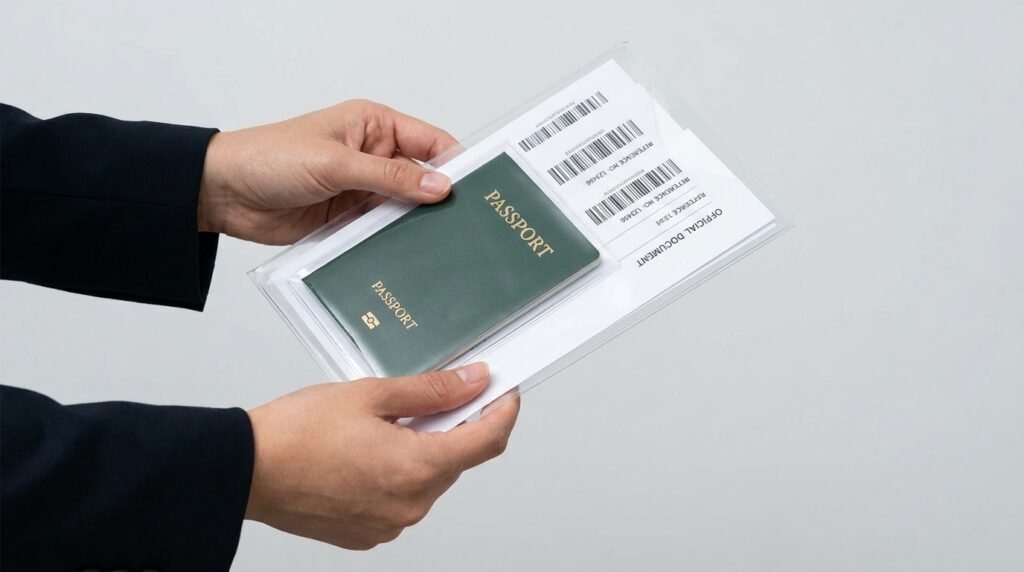
Rehearsing f1 visa interview questions 2026 is only half the preparation — the file in your hand is the other half. Here’s something almost no guide tells you: the US Mission in Pakistan states that, apart from the Form I-20 for student applicants, the consulate has no specific list of required supporting documents. Its own guidance says applicants “should bring whatever documentation they believe would substantiate their position in Pakistan and their purpose of travel” — and the officer may or may not look at any of it.
That freedom is a trap. Bring a thin, ordered file:
- Valid passport (and any old passports with prior US visas or refusals)
- Form I-20, signed by you and your DSO
- DS-160 confirmation page with barcode
- MRV fee receipt and SEVIS I-901 payment confirmation
- Interview appointment confirmation letter
- Sponsor’s bank statements — 6 to 12 months, not a one-day balance certificate
- Sponsor’s FBR tax returns (last 2–3 years)
- Sponsor’s employment letter or business registration
- Scholarship or assistantship award letter, if any
- Academic transcripts and degree certificates
- IELTS/TOEFL and GRE/GMAT score reports
- Documents for property or business you own
- Employment letter and salary slips, if you’ve worked
Leave out: recommendation letters, thick photo albums, laminated certificates, agent-prepared “affidavits of intent to return.” They signal coaching.
Two notes on the paperwork. If you need a clean employer NOC or a sponsor letter drafted in a standard format, PaceDraft’s free document drafting tools will save you a consultant fee. And if you’re comparing destinations on cost rather than prestige, the funding evidence rules for studying in Germany as a Pakistani student work very differently — blocked account, fixed number, no interview judgement call.
Costs and Timeline for a Pakistani F-1 Applicant (2026)
| Item | USD | PKR (approx. @ 278) | Paid to | When |
|---|---|---|---|---|
| SEVIS I-901 fee | $350 | ~97,300 | DHS via fmjfee.com | After I-20, ≥3 business days before interview |
| MRV visa application fee | $185 | ~51,430 | Dept. of State via CGI | Before booking; receipt valid 365 days |
| Mandatory subtotal | $535 | ~148,730 | — | — |
| Visa Integrity Fee (statutory min.) | $250 | ~69,500 | At visa issuance | Rollout uneven — see note |
| Potential total | $785 | ~218,230 | — | — |
Sources: MRV fee — travel.state.gov Fees for Visa Services. SEVIS I-901 — ICE.gov. Visa Integrity Fee — Public Law 119-21.
On the $250 Visa Integrity Fee, sources conflict and you should budget for it either way. Boston University’s ISSO reported in May 2026 that some consular posts had begun charging it at issuance. Several legal advisories published around the same period state it was not yet being collected uniformly, citing incomplete cross-agency coordination. It is charged at issuance, not application — so a refused applicant does not owe it. [VERIFY: whether US Embassy Islamabad / Consulate General Karachi are currently collecting the $250 Visa Integrity Fee — confirm on ustraveldocs.com/pk before your appointment.]
Not applicable to you: the $750 expedited-appointment fee created by a temporary State Department rule effective 1 July–31 December 2026. That pilot covers B-1/B-2 applicants only.
Timeline:
| Stage | Realistic duration |
|---|---|
| Admission to I-20 issued | 2–6 weeks |
| SEVIS + DS-160 + fee payment | 2–5 days |
| Booking to interview date | [VERIFY: current F-1 wait at Islamabad and Karachi — check the official Global Visa Wait Times page] |
| Interview to passport return (clean approval) | Typically within about a week |
| Administrative processing (221g), if applied | Most resolve within 60 days; wait 90 days before inquiring |
Embassy guidance: apply at least six months before intended travel. Check current waits at travel.state.gov Global Visa Wait Times.
Nine Mistakes That Refuse Pakistani Students
You can rehearse every one of the f1 visa interview questions 2026 above and still be refused in ninety seconds by one of these.
1. The parachute deposit. PKR 9 million appearing in an account three weeks before the interview. Officers in high-refusal posts are trained to spot exactly this. Season funds for at least six months, and document any large legitimate deposit with a sale deed, inheritance paper or gift affidavit.
2. Agent-written answers. When four applicants in one morning describe the “vibrant academic ecosystem,” the officer stops listening. Your accent, your city, your father’s actual business — that’s what makes an answer survive. The same rule applies to written documents: the principles in this guide to writing a specific, non-generic study SOP are exactly what an officer is listening for out loud.
3. DS-160 contradictions. Your DS-160 says your father is a businessman; you say he’s retired. That’s not a small slip — it’s a credibility collapse. Print your DS-160 and re-read it the night before.
4. Not knowing your own I-20. Program dates, total cost, school name, major. All of it is on the officer’s screen.
5. Treating a 221(g) slip as a refusal. More on this below.
6. A social media audit you never did. Requirement since June 2025. Old political posts, old handles, forgotten accounts.
7. Applying to an unknown school with a low tuition and a huge “scholarship.” This pattern is heavily associated with visa-driven enrolment and gets extra scrutiny.
8. Over-preparing the emotional close. Pleading, family sacrifice speeches, “this is my only chance.” Officers decide on evidence.
9. Buying tickets before approval. The embassy explicitly warns against non-refundable bookings pre-issuance.
Four Things That Actually Help
Insider hack 1 — Understand what a 221(g) really means for F-1 applicants in 2026. Reporting on the June 2025 State Department cable, the National Law Review noted that once an F, M or J applicant is found otherwise eligible, the officer must still refuse the case under INA §221(g) so that enhanced post-interview online vetting can be completed. Read that again. Under the current procedure, a 221(g) slip can be the paperwork step that follows a favourable assessment. Panicking, reapplying immediately, or hiring an agent to “fix” it usually makes things worse.
Insider hack 2 — Book the appointment, not the date. The MRV receipt rule in Pakistan means scheduling inside 365 days is what counts, not interviewing inside it. Applicants who think they’ll lose their $185 often panic-book a bad early date.
Insider hack 3 — Use both posts. Islamabad prioritises F and J. Karachi prioritises F and J plus most work categories. Applicants in Pakistan can compare availability across posts through the CGI portal rather than waiting on one.
Insider hack 4 — Prepare your answer to the 15 September 2026 rule. If your programme is longer than four years, or you already hold a US degree at the same level, know exactly how the new fixed-admission rule applies to you before you sit down. An officer who raises it and gets a blank look has just found your weak point.
And the uncomfortable part: at a 71% refusal rate, a parallel application is not pessimism, it’s arithmetic. Plenty of the students I’ve worked with kept a live application to a UK study visa from Pakistan or a tuition-free German programme running alongside the US one. Nobody at the counter in Islamabad will ever ask, and if the answer is no, you haven’t lost a year.
A Case That Shows the Pattern
The following is drawn from applicants I’ve helped prepare; identifying details are changed.
A student from Model Town, Lahore — call him Hamza — was refused at Islamabad in the 2025 cycle with an I-20 from a solid Midwestern state university and a 3.6 CGPA. Two minutes, no documents requested, 214(b) slip.
His answer to “who is sponsoring you” had been: “My father, he has a good business.”
The second time, the answer was: “My father, he owns Rehman Fabrics in Faisalabad — twenty-two employees, registered since 2009. His declared income last year was PKR 14.2 million on his FBR return, which I have here. The money for my first year has been in a Meezan account since 2021.”
Same father. Same business. Same money. The difference was that the second version could be checked, and the first one couldn’t.
That is the whole game, and it is why the f1 visa interview questions 2026 that matter most are the financial ones. Officers are not asking whether your family is rich. They’re asking whether your story has edges they can test.
FAQs
How long is the F-1 visa interview at Islamabad or Karachi?
Most F-1 interviews at US posts in Pakistan last two to four minutes. Officers typically ask five to ten questions covering your study plan, funding and ties to Pakistan. A short interview is not a bad sign — many approvals happen in under three minutes, and long interviews often mean the officer is working through a doubt.
What is Section 214(b) and why do most Pakistani students get refused under it?
Section 214(b) of the Immigration and Nationality Act presumes every nonimmigrant applicant intends to immigrate permanently. You must prove otherwise. Pakistani F-1 applicants faced a 71% refusal rate in 2025 per Shorelight’s analysis of State Department data, with most refusals resting on unconvincing home ties or untraceable funding rather than academic weakness.
Can I reapply after an F-1 refusal, and how soon?
Yes. There is no mandatory waiting period after a 214(b) refusal, but you must pay the $185 MRV fee again and reapply from scratch with a new DS-160. Reapplying without changed circumstances almost always produces the same result. Fix the specific weakness — seasoned funds, a documented job offer, a clearer study plan — before booking again.
Do I need to make my Instagram public for a US student visa?
Yes. Since 18 June 2025, the State Department instructs all F, M and J visa applicants to set the privacy settings on every social media profile to public so consular officers can review them. This covers all handles you listed on the DS-160 from the past five years, including dormant accounts on Facebook, X, TikTok, LinkedIn and Reddit.
Is Pakistan affected by the US travel ban for student visas?
No. Pakistan appears on neither the full nor the partial suspension list under Presidential Proclamation 10998, effective 1 January 2026. Pakistan is on a separate pause affecting immigrant visa issuance from 21 January 2026, which does not apply to F-1 student visas. Pakistan is also not on the visa bond list.
How much money do I need to show for an F-1 visa from Pakistan?
There is no fixed figure. You must document funds covering the first year’s total cost as stated on your Form I-20, plus a credible plan for later years. For a typical US master’s this means roughly $25,000–$60,000 for year one. Funds should be seasoned for at least six months, with tax returns and business records backing the sponsor.
What happens if I get a 221(g) slip after my F-1 interview?
Your case goes into administrative processing rather than being finally refused. For F, M and J applicants, current State Department procedure requires officers to refuse otherwise-eligible cases under 221(g) so enhanced online vetting can be completed after the interview. The US Mission in Pakistan says most administrative processing resolves within 60 days and asks applicants to wait 90 days before inquiring.
Does the September 2026 duration of status rule affect my interview?
Indirectly, yes. From 15 September 2026, F-1 students are admitted for their I-20 program length capped at four years, not open-ended “duration of status.” Students completing a US degree after that date cannot begin another programme at the same or lower level. Answers implying an open-ended or repeated US study plan now conflict with the regulations
Can I mention OPT in my F-1 interview?
Yes, and pretending not to know what OPT is looks worse than mentioning it. OPT is a lawful part of F-1 status. Frame it as optional practical training tied to your field, not as a step toward staying permanently. Note that as of August 2026 the administration was reported to be considering a $100,000 OPT fee, though no policy has been formally announced.
Which is better for F-1 interviews, Islamabad or Karachi?
Neither post is easier — refusal decisions rest on your case, not your location. US Embassy Islamabad prioritises student and exchange visitor visas, while Consulate General Karachi prioritises those plus most temporary worker categories. Applicants in Pakistan can compare appointment availability across posts through the CGI portal at ustraveldocs.com/pk.