
Let me be real with you for a second.
Every year, thousands of Pakistani students Google “study in germany for pakistani students” and land on the same recycled, copy-paste articles full of outdated info, wrong numbers, and zero practical advice. They follow that advice. They waste months. Some lose their visa. Some lose money to consultants who don’t know the APS process from a parking ticket.
This guide is different. I’m going to walk you through the actual 2026 ground reality — the timelines, the traps, the financial requirements, and the documents that will either get you to Germany or get your visa rejected. I’ve seen both outcomes. You want to be in the first group.
So if you’re serious about planning to study in Germany for Pakistani students’ most popular destinations like TU Munich, RWTH Aachen, or Heidelberg… read this carefully. All of it.

Why Choose Germany from Pakistan in 2026?
Honestly, the answer hasn’t changed. It just keeps getting more obvious.
Germany is one of the very few countries in the world where public universities charge zero tuition fees — even for international students. You heard that right. Not a “scholarship.” Not a special program. The default. Most public universities in Germany charge only a semester contribution of around €300–€400, which covers your public transport pass and some admin fees. That’s it.
Compare that to the UK (£20,000+/year), Canada (CAD 25,000+/year), or Australia (AUD 30,000+/year). Germany is in a completely different league for value.
But here’s the thing people don’t talk about enough in 2026: the post-study work opportunities have gotten even better. Germany updated its immigration framework to allow international graduates to stay for up to 18 months to job hunt. Plus, while you’re studying, you’re allowed to work up to 140 days per year (or 280 half-days). That’s roughly 20 hours a week — enough to cover your living expenses if you manage it right.
Cities like Berlin, Munich, and Stuttgart have a massive demand for tech, engineering, and healthcare talent. And Germany has a huge shortage of skilled workers right now. The opportunity is real.
The downside? The process is brutally bureaucratic. But that’s exactly why you need this guide.
The Mandatory APS Certificate: Your First Battle

This is where most Pakistani students get blindsided.
The APS Certificate (Akademische Prüfstelle) is a mandatory academic verification document required for all Pakistani students before applying to a German university or getting a student visa. The APS office is located in Islamabad, inside the German Embassy compound.
Here’s the part consultants skip: the current waiting time for an APS appointment in 2026 is running between 4 to 6 months. Sometimes longer. This is your first battle, and it needs to be your first action. Not after you’ve decided your university. Not after you’ve written your SOP. The moment you decide Germany is your goal — apply for APS.
What does APS actually do? They verify:
- Your matriculation, FSc/A-Level, and bachelor’s certificates
- The authenticity of your transcripts
- Your institution’s credibility
The process includes a personal interview in Islamabad where they test your subject knowledge. This interview is in the language of your intended studies — German or English, depending on your program. Don’t take it lightly. Students who walk in underprepared fail the interview and have to reapply.
Documents required for APS (2026):
- Original degree certificates and transcripts (attested by HEC and Ministry of Foreign Affairs)
- Valid CNIC and passport
- Completed APS application form
- Two recent passport-size photographs
- Payment of the APS fee (currently around PKR 15,000–20,000 — confirm current rates at germanembassy.org.pk)
After a successful interview, your APS certificate is issued within a few weeks. Without it, no German university will accept your application, and no embassy will process your student visa. There are zero shortcuts here.
General Requirements for Study in Germany for Pakistani Students
Once your APS process is underway, here’s what else you need to line up.
Educational Documents & Anabin H+ Status
Not all Pakistani universities are treated equally by German universities. Germany uses the Anabin database — a registry maintained by the KMK (Standing Conference of the Ministers of Education) — to assess the academic standing of foreign institutions.
You need to check where your Pakistani university falls in this database. The categories are:
- H+: Fully recognized. Your degree is accepted directly.
- H+/-: Conditionally recognized. Might require additional documents.
- H-: Not recognized. This is a serious problem.
You can check your institution’s status directly at anabin.kmk.org. Search your university name and look under the Pakistan section.
Most major Pakistani public universities — NUST, LUMS, UET, IBA, QAU — are listed as H+. But dozens of private universities are not. If your university has H- status, you’ll need to demonstrate academic equivalence through additional documentation, and many German universities will simply reject your application outright.
Check this before you do anything else. Seriously.
Language Proficiency: IELTS vs. German Language (The 2026 Reality)
Here’s a question I get constantly: “Do I need to learn German to study in Germany?”
The honest answer: it depends entirely on the program you’re applying to.
Germany has massively expanded its English-taught master’s programs over the last decade. In 2026, there are over 1,800 English-taught programs at German universities — mostly at the master’s level. For these programs, you need IELTS Academic 6.5+ (some programs require 7.0) or a TOEFL iBT score of 90+. No German required.

However, if you’re applying to German-taught bachelor’s programs (which are cheaper to access and more available), you’ll need at least B2-C1 level German according to the Common European Framework (CEFR). Most competitive programs want C1. That means Goethe-Institut certification, DSH exam, or TestDaF.
My advice for 2026? If you’re applying straight from FSc or a Pakistani bachelor’s, target English-taught master’s programs. It’s faster, and German universities offering these programs are used to international applicants. If you have the time to invest 1.5–2 years in German language learning, the bachelor’s route opens up completely different opportunities — including easier access to tuition-free programs in all states (including Baden-Württemberg, which charges non-EU students ~€1,500/semester for non-German-taught programs).
The Financial Reality: Blocked Account Germany 2026 Updates
Let’s talk money. Because this is where applications fall apart.
To get a German student visa, you are required to prove you can financially support yourself. Germany does this through a blocked account (Sperrkonto). This is a special bank account opened at a German bank (Fintiba, Expatrio, and Deutsche Bank are the most common for international students) where you deposit a fixed amount that’s then released monthly while you’re studying.

The official 2026 blocked account requirement is €11,904.
This is the updated annual amount set by German authorities. It breaks down to €992 per month. You must deposit the full €11,904 before your visa appointment. The German embassy in Islamabad will not accept anything less.
Here’s the reality for Pakistani families: at current exchange rates, €11,904 is approximately PKR 3.5–3.7 million. That’s a significant commitment. Some families take loans. Some save for years. Whatever your situation, this amount is non-negotiable.
The account setup process with providers like Fintiba or Expatrio takes about 5–10 business days after document submission. Fintiba’s fee is around €89, and they’re generally the most reliable option for Pakistani applicants based on current community feedback.
One thing people forget: the blocked account is separate from your flight costs, health insurance, and initial settlement costs. Budget an additional €1,500–€2,000 for those.
Decoding the Uni-Assist & VPD Process
If you’re applying to universities that use Uni-Assist (and most do), brace yourself for a process that’s frustrating, slow, and costs money at every step.
Uni-Assist is a centralized application portal used by over 170 German universities to assess international applications. Instead of applying directly to each university, you submit through Uni-Assist, which then forwards a verified application to the university.
The costs: €75 for the first university application, and €30 for each additional one. These are non-refundable, regardless of outcome. Students lose money here every year by applying to universities before properly researching admission requirements.
The VPD (Vorabauswertung) is a preliminary document assessment service by Uni-Assist. It’s required by many universities and costs extra (around €50–€75 more). Basically, Uni-Assist checks if your Pakistani credentials meet German admission standards before the university even sees your application.
My advice: apply to a maximum of 5–6 universities. More than that and you’re burning money without strategic benefit. Research each university’s specific requirements, average admitted GPAs, and English proficiency thresholds before you pay anything.
Step-by-Step Visa Process for Pakistani Students
Once you have an admission letter, the real bureaucratic adventure begins.
Booking the VFS/Embassy Appointment (Islamabad vs. Karachi)
Pakistan has two main points for German student visa applications:
- German Embassy Islamabad — handles student visas directly. Priority if you’re in Punjab, KPK, Balochistan, or AJK.
- VFS Global Karachi — handles applications for Sindh residents. VFS forwards documents to the embassy for processing.
Appointment availability in 2026 is tight. Students report 2–4 month wait times for embassy appointments. Book the moment you have your admission letter. Don’t wait for blocked account confirmation or other documents — get in the queue.
At the appointment, you’ll submit a full document dossier. The checklist includes:
- Valid passport (minimum 1 year validity beyond course duration)
- APS Certificate
- Admission letter from German university
- Proof of blocked account (€11,904 confirmation)
- Health insurance (German student insurance, minimum coverage)
- Biometric photographs
- Completed visa application form
- Motivation letter / Statement of Purpose
Most of this list is straightforward. But one item on it destroys thousands of applications every single year…
The “Motivation Letter” Trap: Why 40% of Visas Get Rejected
Look, I need to be brutally honest here.
The motivation letter (also called the Statement of Purpose or SOP) is the single most important document in your German student visa application — and it’s also the most commonly rejected one.
German embassy officers in Islamabad are experienced. They have seen thousands of motivation letters. They can spot a generic, AI-generated, template-copied document in under two minutes. And when they do? Rejection. Not just for the document — for the application.
A rejected SOP signals to the officer that you either lack genuine motivation or you’re hiding something. The standard data circulating in the German student community suggests that close to 40% of student visa rejections from Pakistan are linked to weak, generic, or poorly structured motivation letters that fail to demonstrate a real connection between the applicant’s academic background, chosen program, and future goals.
The letter needs to answer three things with pinpoint specificity:
- Why this specific program at this specific university?
- Why Germany and not the UK, Canada, or your home country?
- What’s your plan after graduation — and why does it require a German degree?
Generic answers fail. “I want to broaden my horizons” — rejected. “Germany is a hub of technological innovation” — rejected. Embassy officers want your story, your numbers, your logical chain.
This is exactly where PaceDraft.com comes in. PaceDraft uses AI trained on successful German visa SOPs to help Pakistani students build tailored, program-specific motivation letters that answer exactly what embassy officers are looking for — not the generic template that 500 other applicants submitted this month. The tool prompts you for your actual academic background, specific program details, and career goals, then constructs a document that reads like it was written by a human consultant who knows German admissions inside out. Because that’s the standard it’s built to hit.
Consultant vs. Reality: What They Don’t Tell You

Here’s a comparison table every Pakistani student needs to see before paying a consultant PKR 150,000 for “guidance.”
| What Consultants Say | The Actual Reality |
|---|---|
| “Process takes 3–4 months” | With APS backlog + visa wait = 10–14 months minimum |
| “Any Pakistani university works” | Anabin H- institutions can disqualify your application entirely |
| “We’ll write your SOP for you” | Most consultant SOPs are recycled templates — embassy officers know |
| “Blocked account is around €10,000” | 2026 requirement is €11,904 — outdated info costs you |
| “IELTS 6.0 is enough” | Most competitive programs require 6.5–7.0 |
| “We guarantee admission” | No one can guarantee this. Admissions are merit-based. |
| “German language is optional” | Only for English-taught master’s. Bachelor’s require B2-C1. |
The real deal is: most consultants in Pakistan are charging premium fees for information that’s freely available online. What you’re actually paying for is document handling — and even that, you can do yourself with the right guidance.
Save the consultation fee. Use it for your blocked account.
Scholarships in Germany for Pakistani Students (DAAD & Beyond)
Free tuition is great. But living costs in Germany are real. Here are the main scholarship options available to Pakistani students in 2026:
DAAD Scholarships The Deutscher Akademischer Austauschdienst (DAAD) is Germany’s premier scholarship organization and the single best resource for Pakistani students. Visit daad.de to search their full database. Key DAAD programs for Pakistanis:
- DAAD Development-Related Postgraduate Courses (EPOS): For students committed to contributing to Pakistan’s development post-graduation. Covers tuition, monthly stipend (~€934), health insurance, travel allowance.
- Helmut-Schmidt Programme: For professionals from developing countries targeting public policy and management master’s programs.
- DAAD Study Scholarships: For exceptional undergraduates applying to German master’s programs.
Application windows vary but most DAAD deadlines fall between October and January for programs starting the following year. Apply early. Competition from Pakistani applicants is extremely high.

Other Options:
- Heinrich Böll Foundation: For students aligned with green politics and social justice. Very competitive.
- Friedrich Ebert Foundation: For socially engaged students with financial need.
- Erasmus+: If you’re already in a partner institution, Erasmus+ mobility grants can cover part of your German studies.
- University-specific scholarships: RWTH Aachen, TU Munich, and several other universities offer merit scholarships for top international applicants. Check individual university financial aid pages.
Realistically, scholarships are competitive. Build your application around Germany’s value proposition — free education + 140 working days/year + 18-month post-study visa — and plan your finances assuming you don’t get a scholarship. If you do, great. If not, you’re not stuck.
Final Word: The Honest Reality of Studying in Germany from Pakistan in 2026
Is it worth it? Genuinely, yes.
The combination of free tuition, strong post-study work rights, 140 working days per year, and access to Europe’s largest economy makes Germany arguably the best value proposition in international education for Pakistani students right now.
But the process is not kind to the unprepared. APS takes months. Blocked accounts take money. Embassy officers are experienced and unforgiving toward generic applications. The students who make it to Germany aren’t necessarily the smartest ones — they’re the ones who started early, did their research, and put real work into every document.
If you’re serious about the journey to study in Germany for Pakistani students, treat every document in your application with the seriousness it deserves. Your SOP and motivation letter are not formalities — they are your voice in a room you can’t enter. Make them count.
Use every tool available to you. Check anabin.kmk.org for your university status. Apply for DAAD funding at daad.de. Use platforms like PaceDraft.com to make sure your documents are tailored, professional, and built to pass the scrutiny of an embassy officer who has seen everything.
Germany is waiting. The question is whether your application is ready.
Last updated: March 2026 | Written for PaceDraft
What is the minimum GPA required to study in Germany for Pakistani students?
There’s no universal GPA cutoff, but the practical reality for competitive programs is this: for English-taught master’s programs at top universities (TU Munich, KIT, RWTH Aachen), you want a CGPA of 3.0/4.0 or above from an H+ institution. Some programs explicitly state 3.2+ requirements. For less competitive universities and programs, 2.5+ can work. The APS certificate process also evaluates your academic performance, so low grades can hurt you there too.
Is there an age limit for study in Germany for Pakistani students?
Germany does not have a formal age restriction for student visa applications. However, older applicants (30+) applying for bachelor’s programs may face harder scrutiny from embassy officers about the “reason for delay” in pursuing education. Be prepared to explain your timeline clearly in your motivation letter. For master’s and PhD programs, age is virtually never an issue.
Can I bring my spouse to Germany on a student visa?
Yes — but with conditions. Your spouse can apply for a Family Reunion Visa (Familiennachzug) to join you in Germany. The requirements are:
Proof of sufficient living space in Germany (rental contract)
Proof of sufficient funds to support both of you (blocked account may need to be higher)
Valid health insurance for both
German language proof at A1 level for the spouse (in most cases)
The A1 German language requirement for spouses is the most common hurdle Pakistani families face. Your spouse needs to pass an A1 exam (like Goethe-Institut A1) before the spouse visa can be issued. Start this preparation early.
Can I use PaceDraft for documents other than the SOP?
Absolutely. PaceDraft.com also helps with employer NOC letters, cover letters, and other visa-supporting documents. For Pakistani students building their full German visa application dossier, having well-structured, tailored documents across the board — not just the SOP — significantly improves the overall impression of the application.
How long does the full process take?
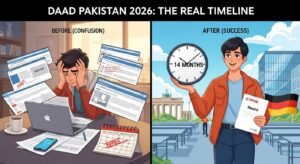
Realistically, if you’re starting from scratch in 2026, plan for 12–16 months from first action to arrival in Germany. Here’s a rough timeline:
Month 1–2: APS application submission
Month 3–6: APS interview and certificate issuance
Month 4–8: University applications via Uni-Assist
Month 6–10: Admission decisions
Month 8–12: Blocked account setup, visa appointment booking
Month 10–14: Visa appointment and processing (4–8 weeks)
Month 12–16: Travel and arrival
Start earlier than you think you need to. The APS backlog alone can derail a full academic year if you miss it.


Pingback: DAAD Scholarship 2027: Pakistan Deadlines & Eligibility