
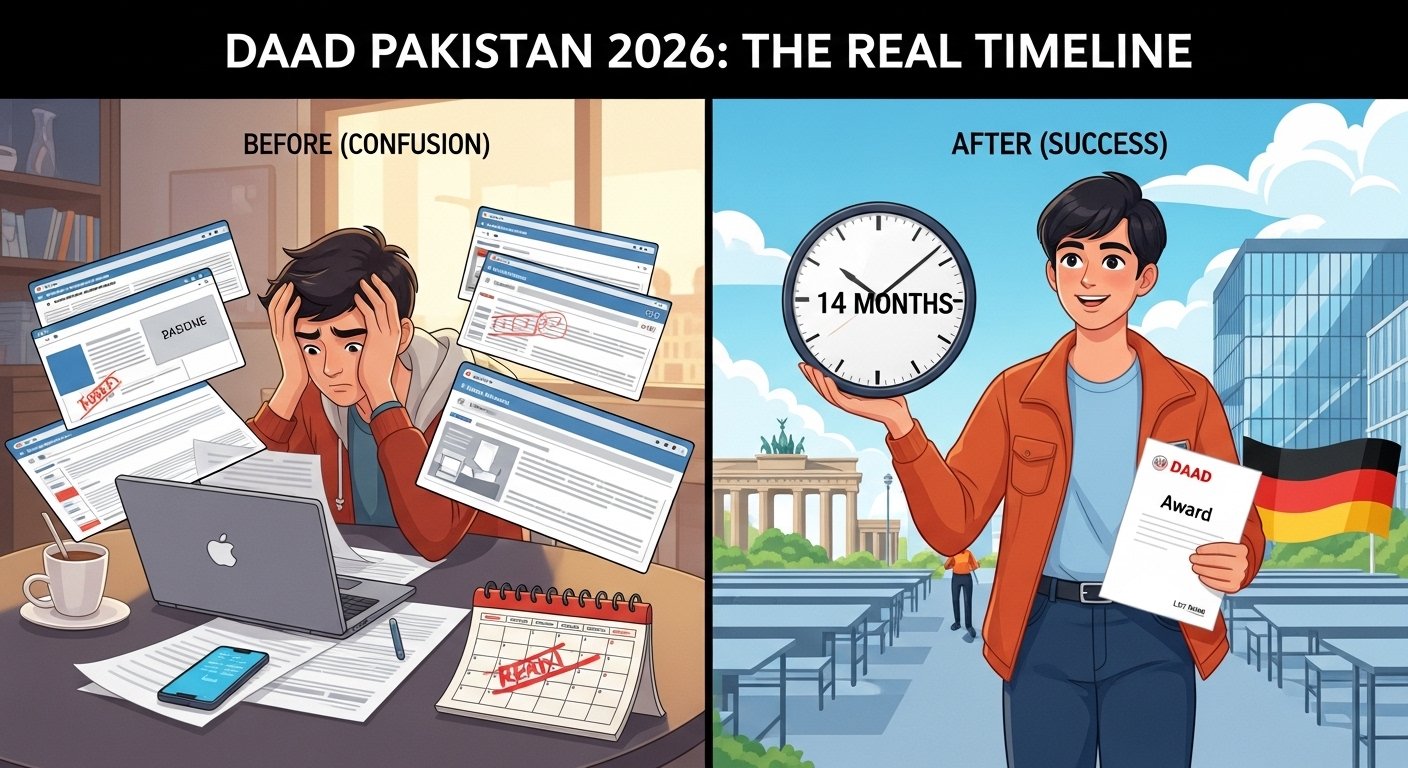
The first time I seriously looked into the DAAD scholarship for Pakistani students, I had four browser tabs open, three contradicting each other on deadlines, and one that hadn’t been updated since 2021. I spent a week reading. Still left confused.
Then I started actually talking to people who had been through the process — at the HEC office in Lahore, in Islamabad waiting rooms, in Facebook groups at 2am — and realized the problem wasn’t a lack of information. It was an overflow of wrong information. Articles that say “start six months before” when the real timeline, once you factor in HEC attestation and the APS certificate queue, is closer to fourteen months. Consultants charging tens of thousands of rupees to tell you things that are freely available, but buried.
This guide exists because of that. If you’re trying to figure out how the DAAD scholarship works for Pakistani students in 2026, I want this to be the only thing you need to read — with the actual numbers, the real Pakistan-specific traps, and the steps in the right order.
The Short Answer
The DAAD (German Academic Exchange Service) offers fully funded scholarships to Pakistani students for Master’s and PhD programs in Germany. Key programs include EPOS and Study Scholarships for STEM. Benefits include a monthly stipend of €992 (Master’s) or €1,400 (PhD as of February 2026), travel allowance, and health insurance. Deadlines typically fall between July and November for the following academic year.
First, What Even Is DAAD — And Why Should You Care?
DAAD stands for Deutscher Akademischer Austauschdienst, which translates to the German Academic Exchange Service. It is the world’s largest funding organization supporting the international exchange of students and researchers, awarding over 100,000 scholarships globally every year.
For Pakistani students specifically, DAAD has a dedicated office. There’s an Information Centre in Islamabad, and DAAD Pakistan actively posts opportunities, PhD positions, and deadlines on their official website at daad.pk.
What makes DAAD different from, say, a random university scholarship? A few things:
- It’s government-backed (funded partly by the German Federal Foreign Office and Federal Ministry for Economic Cooperation)
- It is pre-admission in many cases — you apply for the scholarship first, then the university admission
- It does not have to be repaid. Ever.
- It covers nearly everything: tuition (German public universities often charge zero anyway), living costs, insurance, and your flight
So yes. This is the real deal.
Types of DAAD Scholarships Available to Pakistani Students in 2026
Not all DAAD programs are equal, and not all of them are accessible to Pakistanis. Here are the three main ones you should know:
1. EPOS — Development-Related Postgraduate Courses
This is the biggest one for Pakistani applicants and the most realistic path if you have work experience. EPOS is funded by Germany’s Federal Ministry for Economic Cooperation and Development (BMZ). It targets graduates from developing countries — and Pakistan is on the list.
Who qualifies: You need a Bachelor’s degree (usually four years), at least two years of relevant work experience after your first degree, and strong academic results (upper third of your class is the benchmark).
Fields covered: Public health, environmental management, urban planning, governance, economics, engineering — fields with a development angle.
Key thing to know: EPOS scholarships are tied to specific programs at specific universities. You don’t just apply to “DAAD” generically. You pick a listed postgraduate course from DAAD’s EPOS list and apply through that program. The list for 2026/27 is available on the official DAAD database.
2. Study Scholarships for Master’s (All Disciplines / STEM)
This one is broader. It supports full-time Master’s degree programs in Germany across a wide range of fields. DAAD also runs a specific version for STEM disciplines.
Duration: 10 to 24 months, depending on your chosen program.
Who can apply: Graduates who completed their first degree before the funding begins and plan to pursue a full Master’s in Germany. Your degree should not be older than six years at the time of application.
One limit people miss: You cannot have lived in Germany for more than 15 consecutive months by the application deadline. If you’re already there and have crossed that threshold, check eligibility carefully.
3. Helmut Schmidt Programme
This one is for professionals from developing and transition countries who want to study public policy, development economics, law, or related fields. It’s a bit more niche, but worth knowing if your background is in governance or public administration.
What DAAD Actually Pays You — The 2026 Numbers
This is where most articles get vague. Let’s be specific.
As of 2026, the DAAD monthly stipend is:
- €992/month for Master’s students
- €1,400/month for doctoral/PhD candidates (this amount increased from €1,300 starting February 2026)
On top of that, you receive:
- A flat-rate travel allowance (for your flight to Germany and back)
- Health, accident, and personal liability insurance — fully covered
- A one-off study allowance for initial setup costs
- Depending on the program: rent subsidies and family allowances if you’re bringing a spouse or children
To give this context: €992 a month in a mid-tier German city like Leipzig, Dortmund, or Chemnitz is enough to live comfortably. In Munich or Hamburg, you’ll feel it more — but it’s workable. The insurance alone would cost you €100–€150/month privately.
If you win DAAD, you don’t need a blocked account (which is typically €11,904 for a year). That’s one massive financial headache eliminated.
The Pakistan-Specific Reality: What No One Warns You About
Here’s where I talk from real experience and what I’ve seen fellow Pakistani students go through.

The APS Certificate — Start This NOW
If you’re a Pakistani student applying to a German university, you need something called the APS Certificate (Akademische Prüfstelle — Academic Evaluation Centre). It’s been mandatory for Pakistani applicants since 2022, and in 2026, the wait times have gotten brutal.
Getting an APS appointment in Islamabad currently takes anywhere from 4 to 6 months. After your interview — which is a real academic interview, done via video call, testing your subject knowledge in English or German — the certificate takes another 8 to 12 weeks to arrive.
Total: That’s potentially 7–8 months just for APS, before you’ve even touched your DAAD application.
Before APS: You need your HEC attestation done first. Your transcripts and degree certificates must be attested by the Higher Education Commission of Pakistan. This itself takes time, especially if your university records are messy or your name has any inconsistency between documents.
The sequence is: HEC Attestation → APS Registration → APS Interview → APS Certificate → DAAD Application → German University Application → Visa
Missing any step in this chain costs you months.
The Motivation Letter Problem
I’ve read dozens of motivation letters from Pakistani applicants. The most common mistake? Writing something generic like “I have always been passionate about development and want to contribute to my country.”
DAAD selection committees read thousands of these. What they want is specificity: Which program, which German professor, what research gap you’re addressing, and critically — how your work after returning to Pakistan will contribute to your country’s development. The EPOS program, in particular, explicitly evaluates whether your work is development-related and whether you plan to return.
Write about Pakistan. Be specific about Pakistan’s challenges in your field. That’s your edge.
Bank Statement Shock
If you’re applying for a non-DAAD funded spot alongside your scholarship application (some students do parallel applications), be aware: German consulates require a blocked account of €11,904 for the first year. Converting that to Pakistani rupees at current exchange rates is a significant sum. DAAD scholarship winners bypass this, but you need to have that proof lined up in case your scholarship application fails and you still want to go.
Step-by-Step: How to Apply for DAAD Scholarship as a Pakistani Student in 2026

Let’s get practical.
Step 1: Identify Your Program Go to the DAAD scholarship database at daad.de and filter by your country (Pakistan), level (Master’s/PhD), and field. Shortlist 2–3 programs that match your background.
Step 2: Get Your HEC Attestation Before anything else. Your transcripts, Bachelor’s degree, and any other academic documents must be attested by HEC. Start this process 3–4 months before you think you’ll need it.
Step 3: Apply for APS Register on the APS South Asia website (aps-southasia.de), fill out the application, send attested hard copies via courier (TCS or DHL), and book your video interview slot. Budget 4–8 months total for this step alone.
Step 4: Prepare Your Application Documents
Here’s the standard DAAD checklist for Pakistani applicants:
- DAAD application form (signed and dated)
- Curriculum Vitae in Europass format (handwritten signature)
- Motivation Letter (handwritten signature, 1–2 pages, program-specific)
- Research Proposal (for PhD/research programs — 3–5 pages)
- Two Letters of Recommendation — one academic, one professional
- Official academic transcripts (HEC-attested, translated to English or German)
- Language proficiency proof: IELTS 6.5+ or TOEFL for English programs; TestDaF or DSH for German programs
- Proof of work experience (employment letter + contract), if required by the program
- Employer confirmation and re-employment guarantee (for EPOS)
- APS Certificate
- Copy of passport
Step 5: Submit Through the DAAD Portal or Directly to the University
This depends on your program. Some DAAD scholarships are applied through the DAAD online portal. Others (especially EPOS) are applied directly to the German university offering the listed course — they nominate you to DAAD. Read your specific program’s instructions very carefully.
Step 6: Interview (If Shortlisted) Selection committees review applications and shortlist candidates. If you’re shortlisted, you’ll face an interview assessing your qualifications, motivation, and professional judgment.
Step 7: Visa Application DAAD scholarship holders apply for a German student visa at the German Embassy in Islamabad or the Consulate in Karachi. Your scholarship award letter replaces the blocked account requirement. Still get a VFS appointment early — slots fill up fast.
Realistic Timeline for Pakistani Students Targeting October 2026 Entry
If you’re reading this in April 2026, the October 2026 intake is realistically tight for most DAAD programs — many deadlines have passed. But here’s the timeline to target for October 2027:
| Task | When to Do It |
|---|---|
| HEC Attestation | September–October 2025 |
| APS Registration | October–November 2025 |
| APS Interview | December 2025–February 2026 |
| APS Certificate Received | February–April 2026 |
| DAAD Application Preparation | April–July 2026 |
| DAAD Submission Deadlines | July–November 2026 (program-specific) |
| Selection & Results | January–February 2027 |
| Visa Application | March–May 2027 |
| Arrival in Germany | September–October 2027 |
Total minimum runway from start to landing in Germany: 14–18 months.
Cost Breakdown: What You Actually Pay
Winning DAAD means Germany is nearly free. But the process itself has costs.
| Item | Estimated Cost (PKR) |
|---|---|
| HEC Attestation (per document) | PKR 1,000–3,000 |
| APS Application Fee | PKR 15,000–20,000 (confirm at germanembassy.org.pk) |
| IELTS Exam | PKR 35,000–40,000 |
| Document Translation (certified) | PKR 5,000–15,000 |
| Courier to APS Office (Islamabad, Pakistan) | PKR 1,500–3,000 |
| German Visa Fee | €75 (~PKR 23,000) |
| Flight to Germany | PKR 150,000–250,000 |
Once you’re there and funded by DAAD, your monthly stipend of €992 covers your rent, food, transport, and basics with room to breathe in most cities.
Common Mistakes That Kill Applications

These are patterns I keep seeing, and they cost people the scholarship:
Applying too late. The biggest one. People start preparation in December for an October intake, not understanding the APS timeline.
Sending the same motivation letter to multiple programs. EPOS committees can tell when a letter isn’t program-specific. Each program needs a tailored letter.
Wrong Europass CV format. DAAD explicitly asks for Europass. Sending a creative Canva CV doesn’t work here.
Missing a signature. DAAD application forms, motivation letters, and CVs require handwritten signatures. A scanned printed signature is not accepted. People overlook this and face disqualification.
Not mentioning return plans. EPOS and many other DAAD programs expect you to return to Pakistan after your degree. If your motivation letter sounds like you plan to stay in Germany forever, it hurts your chances.
Weak recommendation letters. “It is my pleasure to recommend…” and then three generic paragraphs about the student being hardworking. Get someone who actually knows your academic work and can speak to your specific contributions.
Pro Hacks — The Stuff That Actually Moves the Needle

Contact the professor before applying. For research-based programs, reaching out to a German professor whose work aligns with yours, explaining your background, and asking about alignment — before submitting — can get you an informal endorsement that strengthens your application. This is legal, encouraged, and very effective.
Use the DAAD Information Centre in Islamabad. This is an underused resource. The DAAD office in Pakistan offers free guidance, application reviews, and information sessions. Their contact is on daad.pk. Many Pakistani applicants don’t know this exists.
Join Facebook groups with active DAAD Pakistan communities. Real current applicants share appointment experiences, interview questions, and timeline updates. This community knowledge is often more current than any published guide.
Apply to multiple DAAD-listed programs simultaneously. You’re allowed to do this. As long as each application is tailored, applying to 2–3 EPOS programs increases your odds significantly.
Start your German even if not required. Many DAAD programs are English-taught, but knowing basic German (A2–B1) is valued by committees, makes integration easier, and opens more local opportunities once you’re there.
One thing I wish I’d had when I was putting my own application together: a tool that generates a structured SOP or cover letter without the blank page panic. If your documents are the next thing stressing you out, PaceDraft has a free cover letter generator built with the exact format German universities and the DAAD process expect. Not a generic template — actually configured for Pakistani applicants. Worth trying before you write anything from scratch.
-
Is DAAD scholarship fully funded for Pakistani students?
Yes. DAAD scholarships cover monthly stipend (€992 for Master’s, €1,400 for PhD in 2026), health insurance, travel allowance, and often additional benefits. You don’t need a blocked account if you have a DAAD award letter.
-
What GPA is required for DAAD scholarship?
DAAD doesn’t state a fixed GPA cutoff, but the EPOS program requires “upper third” academic performance. A CGPA of 3.0/4.0 or 70%+ is a general minimum to be competitive. Higher is always better.
-
Can fresh graduates apply for DAAD?
It depends on the program. The EPOS program requires a minimum of two years of work experience. The Study Scholarship for Master’s programs, however, can be applied for by recent graduates without mandatory work experience.
-
Do I need German language skills for DAAD?
Only if your chosen program is German-taught. Many EPOS and Master’s programs are in English and require IELTS 6.5+ or TOEFL. Always check the specific program requirements.
-
What is the APS certificate and why do Pakistani students need it?
The APS (Akademische Prüfstelle) certificate is a mandatory academic verification document for Pakistani students applying to German universities. It verifies the authenticity of your educational credentials and is required by all German universities and the German Embassy before processing your visa.
-
Can I work while on a DAAD scholarship in Germany?
DAAD scholarship holders are technically permitted to work part-time in Germany. German student visa rules allow up to 140 full days (or 280 half-days) of work per year. However, DAAD’s own guidelines suggest limiting work to avoid affecting studies. Check your specific scholarship contract.
External Links for Reference
- DAAD Pakistan Official Site
- DAAD Scholarship Database
- DAAD EPOS Programme
- APS South Asia Portal
- HEC Pakistan
- German Embassy Islamabad



Heya excellent blog! Does running a blog similar to this require a great deal of work? I’ve very little understanding of coding but I was hoping to start my own blog in the near future. Anyway, if you have any recommendations or techniques for new blog owners please share. I understand this is off subject however I simply needed to ask. Appreciate it!
YES STILL need help?