

⚡ Quick Answer
The APS Certificate Pakistan is a mandatory academic verification document issued by the Akademische Prüfstelle (Academic Evaluation Centre) at the German Embassy in Islamabad. Every Pakistani student applying to a German university needs it before getting a student visa. The fee is approximately €185 (PKR 20,000–30,000), and processing takes 8–12 weeks after your interview. Apply at least 6–8 months before your intended visa date.
I still remember the exact moment I found out about the APS certificate. I was sitting in my room in Lahore, freshly admitted to a Master’s program in Computer Science at TU Berlin, absolutely convinced that the hardest part was over. Then a senior who’d been through this process messaged me:
“Bhai, tune APS apply kiya? Agar nahi toh sab kuch band hai.”
I had never heard of it. Not once. My entire application process — the IELTS prep, the motivation letter, the blocked account research — and this one document had completely slipped past me. Don’t let that happen to you.
Here’s everything you need to know about the APS Certificate in Pakistan in 2026 — from what it actually is, to the step-by-step process, the costs, the interview questions people get wrong, and the real mistakes that cause delays.
What Is the APS Certificate and Why Does Pakistan Need It?
APS stands for Akademische Prüfstelle, which roughly translates to Academic Evaluation Centre. It’s a joint institution run by the German Embassy and DAAD (the German Academic Exchange Service).
Since late 2022, APS has become mandatory for Pakistani, Indian, Bangladeshi, Chinese, and Vietnamese students applying to study in Germany. The reason? Germany wanted a centralized system to verify that academic documents from these countries are genuine — because document fraud had become a real problem in the German university admission pipeline.
Without the APS Certificate, German embassies will not even process your visa application, regardless of how strong your other documents are.
So yes — no APS, no visa. Full stop.
The APS office is located in Islamabad, inside the German Embassy compound. The official application portal for Pakistani students is aps-southasia.de.
Who Needs the APS Certificate in Pakistan?
Every Pakistani student applying for a Bachelor’s or Master’s degree in Germany needs it. There are very few exceptions.
You are exempt if you are:
- Applying for a PhD program (PhD candidates currently do not need APS)
- Holding a full DAAD scholarship (some cases — verify directly)
- Applying for a language course only (not a degree program)
If you fall into any of those categories, great. But for 99% of Pakistani students planning to study in Germany — this certificate is your first and most important step.
Step-by-Step: How to Get Your APS Certificate in Pakistan
Step 1: Get Your HEC Attestation Done First
This is the step everyone skips — and then panics about later.
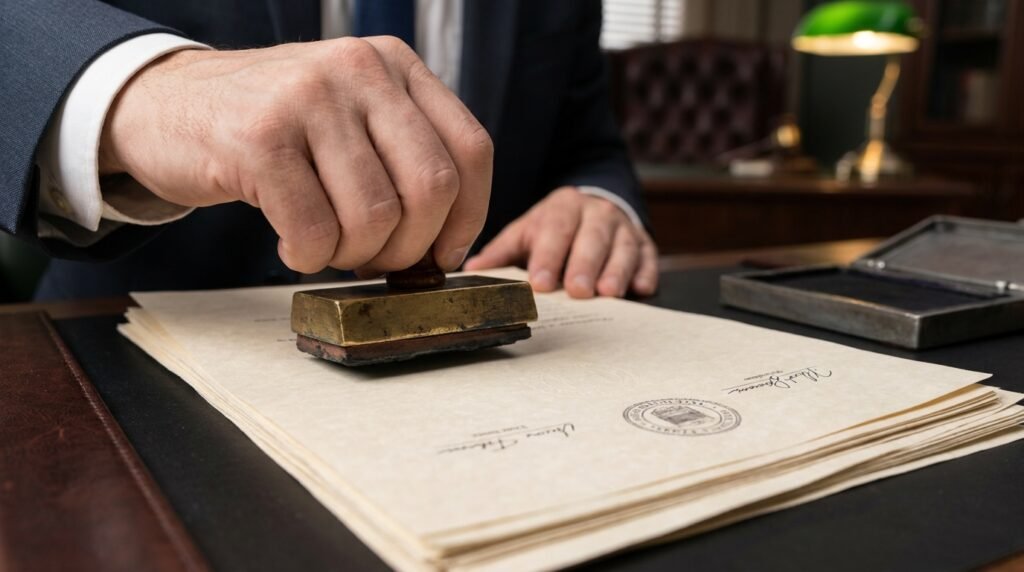
Before you even touch the APS portal, your educational documents need to be attested by the Higher Education Commission (HEC). For Bachelor’s and Master’s applicants, HEC must stamp your university degree and transcripts. For FSc/HSSC level, you’ll go through IBCC instead.
You must apply through the HEC E-Services Portal. You can choose “Walk-in” (urgent) or “Courier Service” (through TCS). HEC requires you to provide your original degrees and transcripts from Matric onwards for verification.
After HEC/IBCC stamps your documents, take them to MOFA (Ministry of Foreign Affairs). MOFA verifies the stamps of HEC/IBCC to give them international “legal weight.” MOFA offices are located in Islamabad, Lahore, Karachi, Peshawar, and Quetta.
Budget 2–4 weeks for this entire chain alone. HEC can be slow, especially during summer when thousands of students are preparing applications simultaneously.
One thing I learned the hard way: your name must match exactly across every document. If your Matric certificate says “Muhammad Huzaifa” but your passport says “M. Huzaifa” — that discrepancy will haunt you. Fix it before you apply, not after.
Step 2: Register on the APS South Asia Portal
Visit the official APS South Asia website (aps-southasia.de) and create an account using a valid email address. Fill out the online application form carefully, ensuring all information about your educational background is accurate and matches your official documents.
Use your full legal name exactly as it appears in your passport. Not your nickname. Not a shortened version. Every field matters here.
Enter each qualification with correct start and end years. Don’t approximate or round off. APS checks consistency of your identity — later, your name and date of birth in APS must match your passport, transcripts, and certificates. Even small spelling differences can slow things down.
Step 3: Prepare and Submit Your Documents
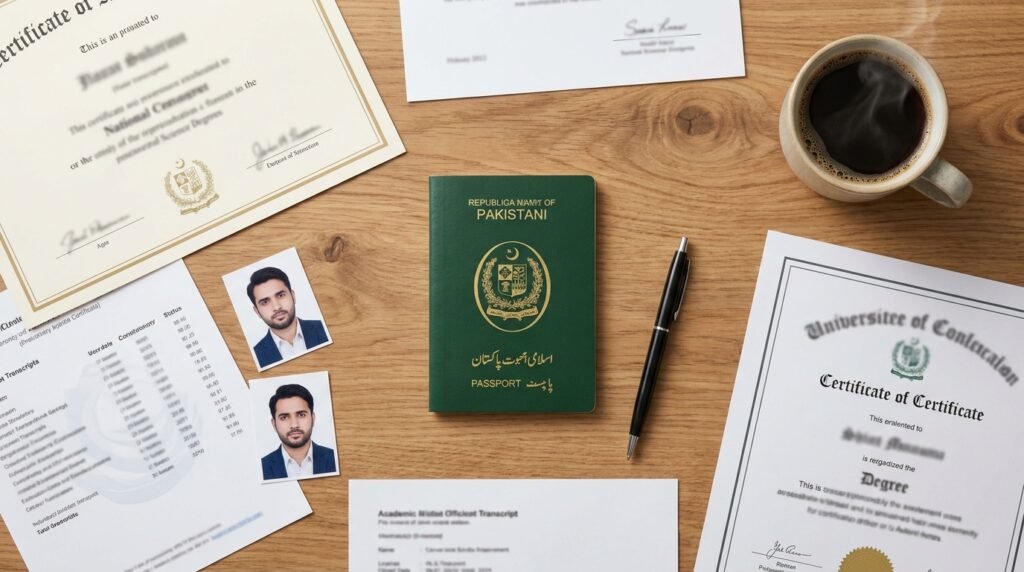
This is the part where most people get confused. Here is the complete APS document checklist for Pakistani students:
For Bachelor’s Applicants:
- Matric Certificate + Transcripts (IBCC attested + MOFA stamped)
- FSc/HSSC Certificate + Transcripts (IBCC attested + MOFA stamped)
- Valid Passport (clear scans of all pages)
- 2 recent passport-sized photographs
- Filled APS Application Form (download from portal)
- Fee payment proof (bank transfer receipt)
For Master’s Applicants (add to the above):
- Bachelor’s Degree Certificate (HEC attested + MOFA stamped)
- Bachelor’s Transcripts (HEC attested + MOFA stamped)
- Proof of minimum passing grade required at your university (this is specific — check your university’s official letter)
One thing that trips up a lot of students: you need to include the minimum CGPA or percentage grade required for a Bachelor’s degree to be awarded at your university. The minimum grade for passing a single course or semester is not sufficient. Get a letter from your university’s Registrar office specifically stating this.
Submit physical copies by courier to the APS office in Islamabad. Use a trackable courier service like TCS or Leopards. Keep the tracking number.
Step 4: Pay the APS Fee
The APS Certificate fee is approximately €185, subject to exchange rate fluctuations. Payment is made via bank transfer to the designated APS account.
In Pakistani rupees, this currently works out to roughly PKR 58,000–65,000 depending on the exchange rate at the time of payment. Keep your bank transfer receipt — it goes in your document package.
One important note: the fee is non-refundable. If your application is rejected or you submit incorrect documents, you don’t get that money back. So make sure everything is correct before sending.
Step 5: The APS Interview

This is where people get nervous — and honestly, it’s the part that matters most.
The APS interview is conducted via video call and typically lasts 20–30 minutes. Interviewers are assessing your genuine knowledge, not expecting you to remember everything perfectly. Honesty and integrity are valued more than perfect answers.
The interview is conducted in either English or German, depending on the language of the program you’re applying for. If you’re applying for a German-taught program, expect at least some questions in German. For English-taught programs, the interview is in English.
What do they actually ask?
For a Bachelor’s applicant, expect questions around your FSc subjects — physics, chemistry, math, biology — basic conceptual stuff. They’re not trying to catch you out. They want to confirm you actually studied what your documents say.
For Master’s applicants, it gets more specific. If your Bachelor’s is in Electrical Engineering, they’ll ask you about circuits, signals, or whatever your major covered. Again, not PhD-level theory — but you need to show you know your field.
A friend of mine, a Civil Engineering graduate from NED University, told me he was asked to explain the concept of bending moment and draw a basic stress diagram. He said the interviewer was perfectly friendly. He passed without any issues because he had genuinely studied what his degree claimed.
Interview prep tips:
- Review your undergraduate core subjects seriously — at least 2 weeks of revision
- Practice explaining concepts in English (or German) out loud
- Know your CGPA, thesis topic (if any), and key courses by heart
- Be honest if you don’t know something. Don’t guess wildly.
Step 6: Wait for Your Certificate
After a successful interview, APS Certificate processing takes approximately 8–12 weeks. The certificate will be sent to your registered address in a sealed envelope and remains valid for 5 years.
You can also track your application status through the APS South Asia portal. If your application goes “on hold,” it typically means they need a clearer scan, a missing document, or a corrected name spelling. Respond quickly to these requests — every day of delay is a day lost.
Approximately 90–95% of genuine Pakistani students successfully receive their APS certification. The system is strict but fair.
The Real Timeline: Planning Your 2026 Application

This is where most guides fail you — they give you the official processing time and call it a day. Here’s the ground reality:
The current waiting time for an APS appointment in 2026 is running between 4 to 6 months. Sometimes longer. This is your first battle, and it needs to be your first action. Not after you’ve decided your university. Not after you’ve written your SOP.
Here’s a realistic timeline if you’re targeting Winter Semester 2026/27 (starting October 2026):
| Stage | Timeline | Notes |
|---|---|---|
| HEC/IBCC + MOFA Attestation | 3–5 weeks | Start immediately |
| APS Registration + Document Submission | Week 5–6 | Do this in parallel |
| APS Interview Wait | 4–6 months | Can overlap with university applications |
| Post-Interview Processing | 8–12 weeks | |
| Total from start to APS certificate | ~9–12 months |
Combine this with visa appointment wait times — current 2026 wait times for standard (Category B) applicants can extend to 10–12 months — and you quickly realize why starting early isn’t just advice. It’s survival.
Rough cost breakdown:
| Item | Approximate Cost |
|---|---|
| HEC Attestation (per document) | PKR 1,000–2,000 |
| IBCC Attestation (Matric/FSc) | PKR 2,000–4,000 |
| MOFA Attestation (per document) | PKR 3,000–5,000 |
| APS Fee (€185) | PKR 58,000–65,000 |
| Courier (TCS/Leopards both ways) | PKR 1,500–3,000 |
| Total (approximate) | PKR 65,000–80,000 |
Currency conversion is rough right now. Budget on the higher end.
Common Mistakes That Get Applications Rejected (or Delayed)

1. Name mismatches across documents Your passport says one thing. Your Matric certificate says another. APS will flag this. Fix name discrepancies before applying.
2. Sending unattested documents Some students skip HEC or MOFA attestation thinking it’s optional. It’s not. Unattested documents will get your application rejected outright.
3. Applying too late With 4–6 month appointment wait times in 2026, applying after you get university admission letters is too late. You should already be in the APS queue when you’re still writing applications.
4. Not knowing your subject for the interview The interview isn’t just a formality. Students who can’t answer basic questions about their own degree field fail the interview. This forces a reapplication — and more waiting.
5. Incomplete document sets Missing the “minimum passing grade” letter from your university. Missing MOFA stamps. Forgetting to include fee payment proof. Any one of these can put your application on hold for weeks.
Pro Tips Most People Won’t Tell You
Get your documents checked at the German Embassy before submitting to APS. The German Embassy in Islamabad offers document attestation services. You can submit your original certificates along with copies and passport. Note that no cross-attestation by HEC Pakistan is required for this specific embassy service. Use this to get at least some documents independently verified.
Apply for APS and university admissions in parallel. You don’t need the APS certificate to apply to German universities — you need it before the visa appointment. So start your Uni-Assist or direct university applications while your APS application is processing.
Track your application obsessively. Log into the portal every few days. If there’s a status change or a clarification request, respond within 24–48 hours. Delays in response = delays in your certificate.
Use a reliable email address and check it daily. Several students miss APS emails because they land in spam. Use Gmail, and mark aps-southasia.de as a safe sender.
After the APS Certificate: What’s Next?
Once you have your APS certificate, the path opens up. You can now:
- Submit your admission applications (or finalize pending ones)
- Open your blocked account (€11,904 required for 2026)
- Apply for your German student visa
For a full breakdown of the Germany study process — including blocked account setup and visa appointment strategy — check out PaceDraft’s detailed guide on studying in Germany as a Pakistani student in 2026.
And if you’re also considering scholarships, don’t forget to check whether you qualify for DAAD funding. The DAAD Scholarship guide for Pakistani students covers eligibility, amounts, and the application process in detail. DAAD scholarship holders get priority processing and, in some cases, are exempt from the APS requirement entirely.
One more thing: your Statement of Purpose (SOP) for your German Master’s program is a document that can make or break your visa. If you need help structuring it the right way, PaceDraft has a focused guide on writing an SOP for a Master’s in Germany.
And if you’re thinking about visiting Germany first on a Schengen visa before committing — the Schengen visa guide for Pakistanis walks you through that process too.
Is the APS certificate required for all Pakistani students going to Germany?
Yes. Every Pakistani student applying for a Bachelor’s or Master’s degree at a German university must have an APS certificate. PhD applicants are currently exempt.
What is the APS fee in Pakistan in 2026?
The fee is approximately €185, which converts to roughly PKR 58,000–65,000 depending on current exchange rates. It’s paid via bank transfer and is non-refundable.
How long does APS certificate processing take in Pakistan?
You’re looking at 8–12 weeks after the interview. But factor in the appointment wait time, which in 2026 is running 4–6 months. Total realistic timeline: 9–12 months from first application to receiving the certificate.
Can I apply to German universities without the APS certificate?
Yes — you can apply to universities while your APS is being processed. But you cannot complete your visa application without it.
What happens if I fail the APS interview?
You’ll need to reapply and pay the fee again. Address the reasons for failure — typically not knowing your subject well enough — before reapplying. There’s no limit on reapplication attempts.
Does the APS certificate expire?
The certificate remains valid for 5 years, and is valid for applications to multiple German universities.
Is HEC attestation mandatory before APS?
Yes. Your Bachelor’s degree and transcripts must be HEC attested before submission. For Matric and FSc, IBCC attestation is required. Then both need MOFA stamping.
Where is the APS office in Pakistan?
The APS office is located within the German Embassy compound in Islamabad. Applications are submitted online via aps-southasia.de, with physical documents sent by courier to the Islamabad office.
Official Resources
- APS South Asia Portal: aps-southasia.de
- German Embassy Islamabad: pakistan.diplo.de
- HEC E-Services (Attestation): eservices.hec.gov.pk
- DAAD Pakistan: daad.pk
Last updated: May 2026. Always verify current requirements directly with APS South Asia and the German Embassy Islamabad, as processes and fees can change without notice.



Hi,
Recently we don’t need Mofa attestation specially for Germany, can you please confirm about this ??
Thanks for explaining every detail step by step.
Yes, MOFA attestation is still mandatory for Germany, but you must request the traditional MOFA stamp instead of the new “Apostille” because Germany has officially rejected Pakistan’s Apostille system. To complete the process, you first need to get your educational and personal documents pre-verified by the relevant local authorities (like HEC, IBCC, or NADRA), then get the standard attestation from MOFA, and finally have them translated into German before submitting them for your visa or university application; without this traditional MOFA seal, your file will be rejected.