

My friend Omar from Multan landed a Dubai job offer last October. Good company, solid salary. He was over the moon. Three weeks later, he called me from Islamabad — frustrated and confused — because his work permit had been flagged by some AI system he’d never heard of. The reason? A two-letter name mismatch. His middle name was “Ahmad” on his HEC degree, “Ahmed” on his passport. That was enough. Application rejected. Back to square one.
That story happens more than you’d think. In 2026, getting a dubai work visa for pakistani applicants is both faster in some ways (the employer-side process is genuinely streamlined now) and stricter in others (AI now catches document inconsistencies that used to slip through). If you’re a fresh graduate or a job seeker figuring out where to start, this is the guide you needed before sending out those applications.
Quick Answer
Getting a Dubai work visa as a Pakistani requires your UAE employer to apply for a MoHRE work permit after you sign a verified, written job offer. You must provide HEC-attested degree documents, a GAMCA medical certificate, and an FIA police clearance. Total processing — from signed offer to landing in Dubai — realistically takes 10–14 weeks. All visa-related costs must be paid by the employer under UAE law.
Is It Still Worth Applying? The Real Picture for Pakistanis in 2026
Let’s address the thing everyone is whispering about. Yes, Pakistani workers face a nationality quota issue in the UAE — but it’s not what you think.
Pakistani workers are heavily concentrated in construction, transport, cleaning, and security, meaning many companies in those sectors have already reached their quota ceiling and cannot issue new Pakistani work visas until the ratio changes. So if you’re applying to a cleaning company or a basic logistics firm, you might hit a wall.
But here’s what nobody tells you: engineers, doctors, IT professionals, and other degree-qualified workers are not overrepresented in the UAE, so this cap rarely applies to them. Skill level is the primary determining factor in visa accessibility in 2026.
If you have a recognized university degree and you’re going into tech, healthcare, finance, engineering, or education — the path is wide open. The UAE actively wants skilled Pakistani talent. The quota issue is real, but it affects unskilled sectors far more than it affects graduates.

Two Types of Companies, Two Very Different Processes
Before anything else, figure out whether your employer is a mainland company or a free zone company. This changes your fee structure, processing route, and which authority issues your permit.
Mainland companies go through MoHRE directly. Most large multinationals and established Dubai businesses are mainland. Free zone companies — registered in zones like DMCC, JAFZA, DIFC, or Dubai Silicon Oasis — operate under their own free zone authority. The document requirements are nearly the same, but free zones can save 30–40% on permit costs compared to mainland.
Ask your HR contact which category they fall under before you make any decisions. It affects timelines and your personal cost share too.
Step-by-Step: How the Dubai Work Visa Actually Gets Done
This is the full process as it stands right now.
Step 1: Get a written, signed job offer
Verbal offers are useless here. You need a signed offer letter with your full name (exactly as on your passport), job title, salary, start date, and contract duration. The name part matters more than ever in 2026 — more on that in a minute.
Step 2: Employer verifies their MoHRE quota
Workers should verify that the UAE employer has a minimum of 25 registered employees, is registered with MoHRE, and has available diversity quota capacity before submitting any documentation or paying any fees. Ask your HR contact to confirm this before you spend a single rupee on document attestation.

Step 3: Employer submits through the Work Bundle
Work Bundle (workinuae) is MoHRE’s integrated platform that consolidates the entire process from 5 separate systems into one, cutting required documents from 16 to 5, steps from 15 to 5, in-person visits from 7 to 2, and processing time from 30 working days down to 5. This is a genuine improvement. Your employer’s HR team will handle this step.
Step 4: The AI “Eye” system scans everything
Since May 2026, the AI system “Eye” reviews each application — checking name consistency, attestation, and qualification fit. This is what caught Omar. We’ll break this down separately below.
Step 5: Entry permit issued — 60 days, not a moment more
Once approved, your employer receives your entry permit. Approved applications generate a pink-paper entry permit valid for 30 days. You must enter the UAE within 30 days of the entry permit’s issue date. Missing this window voids the permit. If you cannot travel in time, the employer must re-issue. Confirm the exact validity window on your permit document — some categories show 60 days — but treat it as urgent regardless.
Step 6: Complete your Pakistan-side documents in parallel
This runs alongside Steps 3–5. Start it the day you sign your offer. The chain: HEC → MOFA Pakistan → UAE Embassy Islamabad. This is your bottleneck (full detail in the next section).
Step 7: GAMCA medical test + FIA police clearance
GAMCA Medical Test Certificate: Conducted at a UAE-approved medical centre in Pakistan. Tests include blood work, chest X-ray, and screenings for tuberculosis, HIV/AIDS, and hepatitis. A ‘FIT’ certificate is required to proceed. Do not use a non-GAMCA medical centre — those results aren’t valid for UAE purposes. Book early; popular centres in Lahore, Karachi, and Islamabad have waiting times of 5–10 days.
Police Clearance Certificate (PCC): Mandatory for virtually all employment visa categories. Issued by the Federal Investigation Agency (FIA) or local police.
Step 8: Travel to the UAE on your entry permit
Carry a printed copy. Don’t just rely on a PDF at Karachi airport immigration.
Step 9: Complete UAE medicals, biometrics, Emirates ID
Within days of arrival, you complete a UAE medical fitness test (blood test and chest X-ray) at an approved government health centre. Then biometrics at an EIDA centre. Processing time for Emirates ID issuance or renewal usually takes 5 to 7 working days.
Step 10: Final residency stamp
Your employer’s PRO handles the final stamping. You are now a legal Dubai resident worker.
The HEC Attestation Chain — Start This Before You Even Get a Job Offer
This is the part 90% of articles brush past in two sentences. Don’t make that mistake.
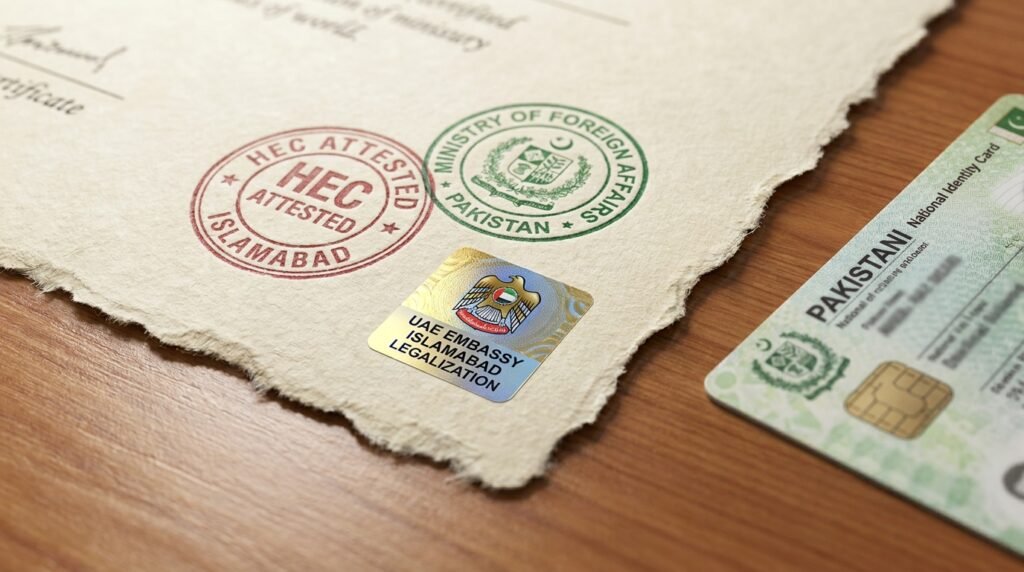
If you hold a Pakistani university degree, your first mandatory stop is the Higher Education Commission (HEC). No MOFA office or Gulf embassy will touch your degree without HEC attestation first.
The full attestation chain for a UAE job:
HEC → MOFA Pakistan (general attestation) → UAE Embassy Islamabad → UAE MOFAIC
Here’s the good news: In May 2026, HEC launched a fully online, paperless Degree Attestation System (DAS) built on blockchain technology — you no longer need to visit HEC offices or submit physical originals to HEC. Register at eservices.hec.gov.pk, upload your degree, transcripts, and CNIC. That’s a genuine relief — no more half-day trips to H-9 Islamabad.
But here’s the thing nobody wants to hear: HEC verification commonly runs 40 to 60 days, and it cannot be safely compressed.
This is your biggest scheduling risk. I learned this the hard way myself, not for a Dubai job, but when I needed my degree verified for a German residence permit. Whether you’re chasing an APS certificate for Germany (covered in detail on PaceDraft’s APS guide) or doing HEC attestation for the Gulf, the lesson is identical: start your document chain the same day you decide to pursue work abroad — not the day you receive an offer.
Also important: The UAE is not a party to the Hague Apostille Convention as of June 2026, so a Pakistani apostille is not legally valid for UAE purposes. You must complete the full embassy attestation chain: HEC/IBCC → MOFA Pakistan (general attestation) → UAE Embassy Islamabad → UAE MOFAIC.
Plan a minimum of 8–10 weeks for the entire chain if you’re starting from scratch.
Dubai Work Visa Fees for Pakistanis: 2026 Full Breakdown
Here’s the news that surprises most applicants: Under UAE Federal Decree-Law No. 33 of 2021, the employer is legally responsible for paying 100 percent of work permit, visa, medical, Emirates ID, and health insurance costs. If a UAE employer asks the worker to pay these fees, that is illegal and a clear red flag.
If any recruiter or company asks you to fund your own work permit — walk away. It’s not just suspicious, it’s against the law.

What the employer pays (your visa costs):
| Component | Approximate Cost |
|---|---|
| Work permit fee — Category A (skilled worker) | AED 300 |
| Work permit fee — Category C (unskilled worker) | AED 5,000 |
| Full mainland employment package (all-in) | AED 3,000 – 7,000+ |
| Emirates ID (validity-dependent) | AED 370 – 570 |
| Express processing (optional) | AED 500 – 1,000 |
Generally, the Dubai employment visa cost in 2026 is between AED 3,000 and AED 7,000. This all-encompassing fee includes visa processing, medical tests, Emirates ID issuance, and residency stamping.
What you pay in Pakistan (out of pocket):
| Component | Approximate PKR |
|---|---|
| HEC online DAS attestation + courier | PKR 5,000 – 15,000 |
| MOFA Pakistan stamp | PKR 3,000 – 5,000 |
| UAE Embassy Islamabad legalization | PKR 5,000 – 8,000 |
| GAMCA medical test | PKR 8,000 – 12,000 |
| FIA Police Clearance | PKR 2,000 – 3,000 |
| Estimated total (Pakistan side) | PKR 23,000 – 43,000 |
For a full breakdown of Dubai visa-related costs from Pakistan, check the dedicated guide at PaceDraft’s Dubai visa cost page.
The MoHRE AI System Is Now Reading Your Documents — What It Actually Checks
This is the biggest change to understand before you apply in 2026.
Beginning May 2026, the Ministry of Human Resources and Emiratisation (MoHRE), together with the Federal Authority for Identity, Citizenship, Customs and Port Security (ICP), implemented an AI- and robotics-driven system to assess work permit applicants.
The system is called “Eye.” It automates application handling, reducing the need for human intervention except in exceptional cases. “Eye” leverages artificial intelligence to verify essential documents such as personal photos, passports, and academic certificates, ensuring accuracy and authenticity while minimising human error.
What this means in practice for Pakistani applicants:
The AI-based verification engine cross-checks passports, Emirates IDs, and employment contracts in real time across multiple government databases. Employers now receive work-permit quota approvals instantly, while previously they waited up to 10 days.
The top triggers for rejection in Pakistani applications:
- Name spelling mismatches — “Ahmad” vs “Ahmed,” “Mohammed” vs “Muhammad” across passport, degree, and offer letter. The AI flags these automatically.
- Incomplete attestation chain — degree not yet attested by MOFA or UAE Embassy
- Job title vs. qualification mismatch — your offer letter says “Software Engineer,” your degree says “Commerce.” Expect a flag.
If your application is rejected, Ministry decisions can be appealed within 30 working days of notification through the MoHRE portal’s “Grievance” service. You’ll need to address whatever issue was flagged, such as a credentials mismatch or document error.
The AI is not the enemy. It just doesn’t tolerate careless document preparation the way a tired human case officer occasionally did.
Realistic Timeline: Pakistan to Dubai, Week by Week
Here’s an honest picture — not the sales-pitch version.
| Week | What You’re Doing |
|---|---|
| Week 1–2 | Sign offer, start HEC DAS online application immediately |
| Week 2–3 | GAMCA medical appointment booked + FIA Police Clearance submitted |
| Week 3–7 | HEC verification underway (this is your 40–60 day bottleneck) |
| Week 3–6 | Employer submits Work Bundle to MoHRE; AI “Eye” review |
| Week 7–8 | MOFA Pakistan attestation + UAE Embassy Islamabad legalization |
| Week 8–10 | Entry permit issued after AI approval |
| Week 10–12 | Travel to Dubai on entry permit |
| Week 12–14 | UAE medicals, biometrics, Emirates ID, final residency stamp |
Realistic total: 10–14 weeks. Anyone promising you 3 weeks is either skipping steps or selling you false confidence. For unskilled categories or when the quota issue needs resolving, it can push past 16 weeks.
Mistakes That Get Pakistani Applicants Rejected (Plus Real Hacks)
Mistake 1: Not checking the company’s MoHRE registration before signing
I’ve seen people quit Pakistani jobs and fly to Dubai on a tourist visa assuming they’ll “sort the work visa on arrival.” That’s not how this works. Confirm registration status, minimum employee headcount, and quota availability before you make any life decisions.
Mistake 2: Name inconsistencies across documents
This is now a direct AI rejection trigger and it’s entirely avoidable. Check your passport, degree, CNIC, matric certificate, and offer letter. If there’s a mismatch — any mismatch — get a notarized affidavit, or get the degree reissued if possible. Do not assume the system will “understand.”
Mistake 3: Waiting for a job offer to start HEC attestation
The biggest scheduling mistake Pakistani graduates make. Start the HEC chain the day you decide to work abroad. HEC takes 40–60 days. That delay has cost people their job offers when the entry permit expired before they could travel. I’ve seen it happen.
Mistake 4: Using non-GAMCA medical centres
Results from non-approved centres are invalid for UAE purposes. Use only listed GAMCA centres. Find your nearest approved one at the official GAMCA Pakistan website before booking.
Mistake 5: Accepting a verbal job offer and burning documents on it
If it’s not in writing — salary, title, duration — it doesn’t exist legally. Never start attestation costs based on a WhatsApp message from an “HR manager.”
Pro Hack 1: Do your GAMCA test and FIA PCC simultaneously with HEC
These two processes run independently. You don’t need HEC to be done to book GAMCA. Run them in parallel and save 2–3 weeks.
Pro Hack 2: If you’re already inside the UAE on a visit visa
If a Pakistani national is inside the UAE on a valid visit or tourist visa and secures a verified job offer from a registered UAE employer, they can apply for an in-country status change through the ICP or GDRFA portal. No need to fly back to Pakistan. Ask your employer’s PRO to confirm whether this applies to your situation — it’s a significant time and cost saver.
Pro Hack 3: Check if you qualify for the Green Visa instead
Green Visa (5 years, no employer sponsor required): Available to skilled workers earning AED 15,000 or more per month, or freelancers with an annual income of AED 360,000 or above. If you’re an experienced professional with a strong salary offer, ask your employer whether it makes more sense to go the Green Visa route. You get 5 years of self-sponsored residency, meaning you’re not dependent on a single employer for your legal status. That’s a major stability upgrade.
Pro Hack 4: Use the Overseas Employment Corporation (OEC) for unskilled routes
The safest route is through the Overseas Employment Corporation (OEC) of Pakistan, which operates under the government and maintains official quotas with UAE employers. OEC processes workers through verified, government-to-government channels, significantly reducing the risk of fraud, fake job offers, or rejected applications.
Dubai vs Europe: A Real Comparison for Pakistani Graduates
I get this question constantly. My friends in Germany, Austria, and Italy all weigh the same trade-offs. Dubai gives you higher take-home salary (no income tax), faster visa processing, zero language barrier in a professional setting, and a strong Pakistani community support network. Europe gives you post-study work rights, permanent residency pathways, and exposure to a different professional environment.
If you’re weighing your options, PaceDraft covers the full picture: the UK study visa from Pakistan, studying in Germany in 2026, and even the Italy study visa route are all live articles. For the finances side of studying or working abroad, the PaceDraft finances guide is worth bookmarking too.
For a pure work visa as a first international move — especially for someone who needs income quickly without a master’s degree — Dubai remains the most accessible entry point. The paperwork is manageable. The timeline is predictable. And if you have an HEC-recognized degree with clean documents, approval rates for skilled categories remain high in 2026.
FAQS
Does the employer always pay for the Dubai work visa?
Yes, by law. UAE Federal Decree-Law No. 33 of 2021 mandates that employers cover 100% of work permit, medical, Emirates ID, residency stamping, and health insurance costs. If any employer or recruiter asks you to pay these, that is illegal. Walk away.
How long does HEC attestation take in 2026?
The submission is now instant via the new online DAS portal. But the verification itself still takes 40–60 working days, depending on university response speed. Budget two months and start the moment you decide to work abroad.
Can I change my visa status from tourist to work inside the UAE?
Yes, in many cases. If you’re on a valid visit visa and get a legitimate job offer from a registered UAE employer, you can apply for an in-country status change without flying back to Pakistan. Confirm with your employer’s PRO before booking a return flight.
What is the MoHRE “Eye” AI system and why does it matter?
It’s MoHRE’s AI screening engine, live since May 2026. It verifies document consistency, attestation completeness, and qualification matching. Its top rejection trigger for Pakistani applicants: name spelling differences between passport, degree, and offer letter. Make sure all documents match perfectly.
Is there a nationality ban on Dubai work visas for Pakistanis?
No official ban. But nationality quotas exist per employer in certain overcrowded sectors (construction, security, cleaning). Skilled professionals — engineers, developers, healthcare workers, finance professionals — are far less affected by this. Check your employer’s quota before applying.
What’s the Dubai work visa fees for Pakistanis in 2026?
On the Pakistan side (your out-of-pocket cost): roughly PKR 23,000–43,000 covering HEC attestation, MOFA, UAE Embassy legalization, GAMCA medical, and FIA police clearance. The actual visa and residency costs (AED 3,000–7,000+) are legally the employer’s responsibility. Full cost breakdown at PaceDraft’s Dubai visa cost guide.
Is a Schengen visa harder or easier to get than a Dubai work visa?
Different systems entirely. A Schengen visa requires financial proof, travel insurance, and embassy appointments through VFS in Pakistan, and processing can be unpredictable. If you’re comparing both routes for study or travel, PaceDraft’s Schengen visa guide for Pakistanis covers that process in full.