
My cousin in Lahore paid an agent PKR 45,000 in March to “open his APS file” for Germany. Portal login, receipt, WhatsApp updates, the whole show. Four months later he asked me why his tracking page never loaded.
Because there is no tracking page. There is no file. There is no APS office in Pakistan.
If you have been searching for the APS certificate Germany for Pakistani students, this article is going to save you money and probably six months of your life. The requirement you have been reading about is real — it just does not apply to your passport.
Quick Answer
Pakistani students do not need an APS certificate for Germany, because no APS office exists in Pakistan. Germany operates APS only in China, Vietnam and India. Pakistani applicants instead submit degrees directly to uni-assist or the university, plus HEC or IBCC attestation, an anabin recognition check, and a €11,904 blocked account.
Last verified: September 2026. Exchange rate used throughout: €1 = PKR 323.
Where the “APS Pakistan” story actually came from
APS stands for Akademische Prüfstelle, or Academic Evaluation Centre. It is a joint office run by the German Embassy and DAAD, and it exists in exactly three countries.
uni-assist’s own glossary — the organisation that processes applications for roughly 180 German universities — states plainly that the APS exists in China, Vietnam and India. China got it in 2001. Vietnam in 2007. India in October 2022, announced through a formal Federal Foreign Office notice. Mongolia had one, but that office closed in 2019.
Pakistan never got one. There was no announcement, because there was nothing to announce.
Here is the part that should worry you. Almost every blog claiming Pakistanis need APS tells you to register at a website called aps-southasia.de. That domain appears on no German government page, no DAAD page, and no German university page. The real APS portals are aps-india.de, aps.org.cn, and the Vietnam office. A made-up domain got repeated by one AI-written blog, then copied by the next, and now it sits in dozens of articles and a few consultancy websites.
The €185 fee, the “4 to 6 month appointment wait in Islamabad”, the “8 to 12 weeks after your interview” — all of it traces back to that same cluster. None of it appears in a single official source.
Check this yourself in ninety seconds
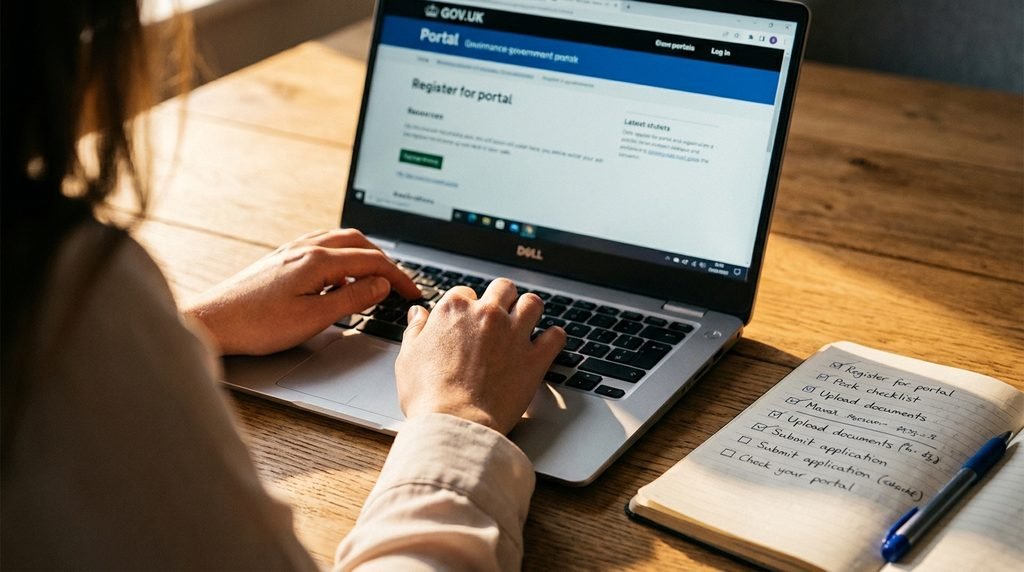
Do not take my word for it. Do not take an agent’s word either. Open these three pages:
| What to check | Official source | What you will find |
|---|---|---|
| Does Pakistan have APS? | uni-assist APS glossary | APS exists in China, Vietnam, India |
| What does Germany actually ask Pakistanis for? | German Embassy Islamabad, student visa page | Degree certificates, transcripts, tuition proof. Zero mention of APS |
| What does a real APS site look like? | aps-india.de | Runs under the Science Section of the German Embassy in New Delhi |
The embassy page was last updated on 27 November 2025. It lists the mandatory documents in detail, including a note that past degree certificates and transcripts are compulsory even though the system currently displays them as optional. If APS were required from Pakistan, it would be the first line on that page. It is not on the page at all.
What replaces APS for you: the anabin check
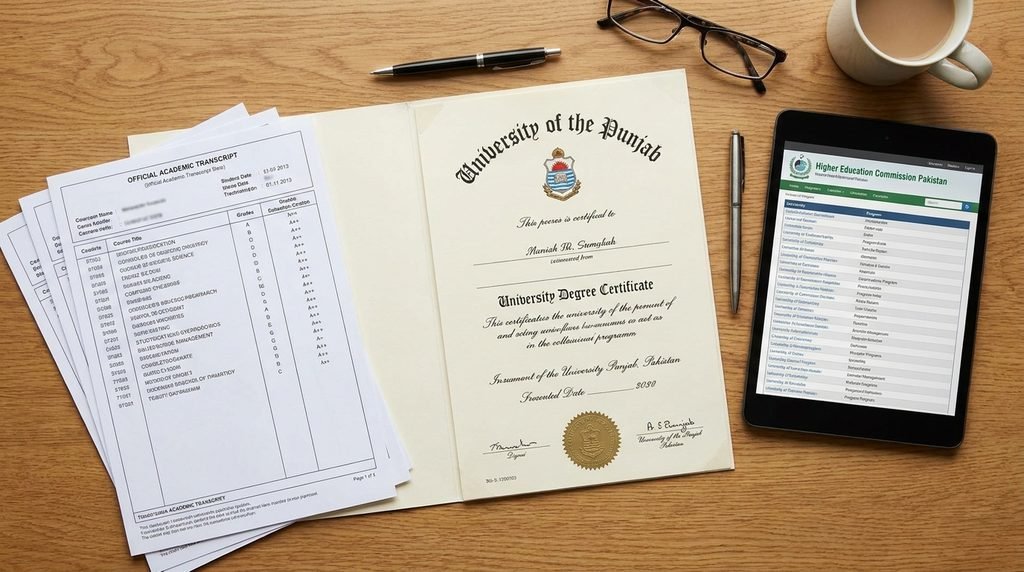
Your degrees still get verified. The check just happens somewhere else, and it costs you nothing to run yourself.
Germany uses a database called anabin, maintained by the Central Office for Foreign Education (ZAB). It rates foreign institutions with three codes:
- H+ — the institution is recognised. Your degree counts.
- H+/- — some programmes count, some do not.
- H- — not treated as equivalent.
Search your university at anabin.kmk.org before you spend a single rupee on applications. If your institution is not listed at all, that is not automatically bad news — the database is incomplete, and you can request a Statement of Comparability from ZAB instead.
Now the uncomfortable part, and most Pakistani guides bury it. An FSc or HSSC certificate on its own is not equivalent to the German Abitur. You generally cannot walk from Intermediate straight into a German Bachelor’s. Your realistic routes are a Studienkolleg year followed by the Feststellungsprüfung, or completing one to two years of university study in Pakistan at an H+ institution first. Master’s applicants with a four-year Pakistani Bachelor’s from an H+ university are usually fine directly.
If nobody has told you this yet, your agent either does not know or is not saying.
HEC attestation for Germany: what changed in May 2026
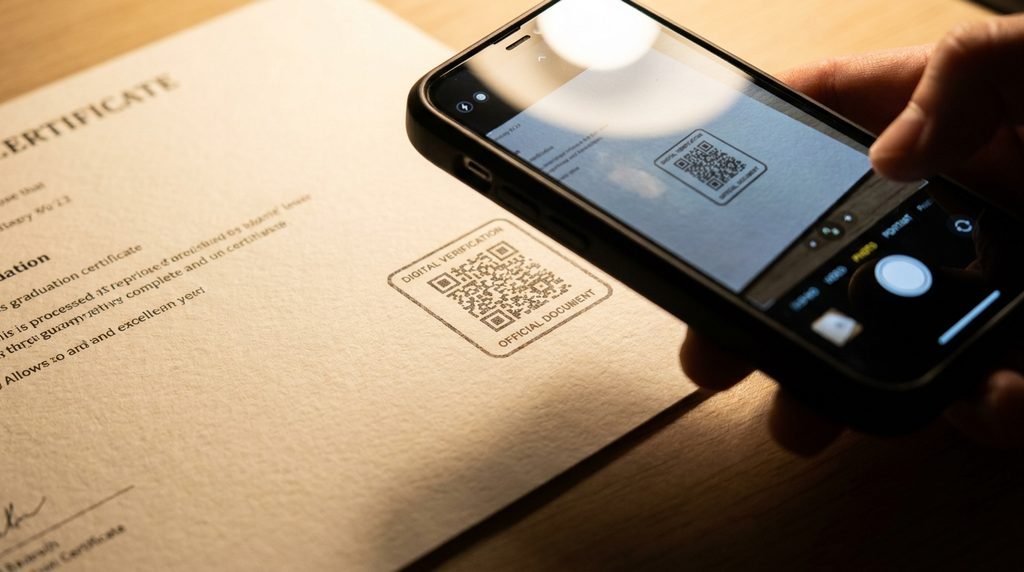
People search for “HEC attestation for APS Germany” constantly. There is no APS, but HEC attestation is genuinely part of your file — universities and the embassy both want documents they can verify.
On 11 May 2026, HEC launched a fully online, paperless Degree Attestation System. No office visit. No couriering your originals to Islamabad. You upload scans at eservices.hec.gov.pk, HEC verifies directly with your university through a backend link, and you download a blockchain-secured e-Attestation Certificate. Applications already paid for under the old system were processed until 30 June 2026. Anything attested before 11 May 2026 stays valid.
Two things to get right:
Your name must match everywhere. Your CNIC, your degree, your transcript, your passport. A missing middle name or a spelling difference between “Muhammad” and “Mohammad” will stall the file. This is the single most common reason Pakistani applications sit in scrutiny.
Matric and Intermediate go to IBCC, not HEC. HEC handles university degrees. IBCC handles SSC and HSSC certificates, and your board must verify the certificate before IBCC will touch it.
For the fee, official and reported figures currently disagree, so I am giving you both rather than guessing. HEC’s own attestation page still displays the older structure of Rs 1,000 per original document and Rs 700 per photocopy. Multiple 2026 reports state the new DAS fee is a flat Rs 3,000 per document, with part of it passed to your university. [VERIFY: confirm the live per-document fee inside your eservices.hec.gov.pk dashboard before paying — do not budget from any blog, including this one.]
The actual step-by-step from Pakistan (2026)
- Run the anabin check. Free, five minutes, and it tells you whether the rest of the plan is even possible.
- Sort your language certificate. English-taught programmes typically want IELTS 6.0–6.5. German-taught ones want TestDaF or a Goethe certificate. English-medium schooling in Pakistan waives nothing.
- Get documents attested. IBCC for Matric and Inter, HEC for your degree and transcript.
- Apply through uni-assist or directly. Around 180 universities use uni-assist. Others take direct applications. Some want a VPD (Vorprüfungsdokumentation), which is a certified grade conversion you then hand to the university yourself.
- Get your admission letter (Zulassungsbescheid). Winter semester deadlines usually cluster around 15 July; summer around 15 January. Confirm per programme, they vary.
- Open a blocked account and get your signature attested. More on this below — it has a trap in it.
- Register on the Consular Services Portal. Islamabad covers Islamabad Capital Territory, Punjab, KP, Gilgit-Baltistan and AJK. Karachi covers Sindh and Balochistan. Apply where your registered home address is, not where you currently live.
- Submit, wait, travel, register your address (Anmeldung), convert to a residence permit.
Documents you actually need
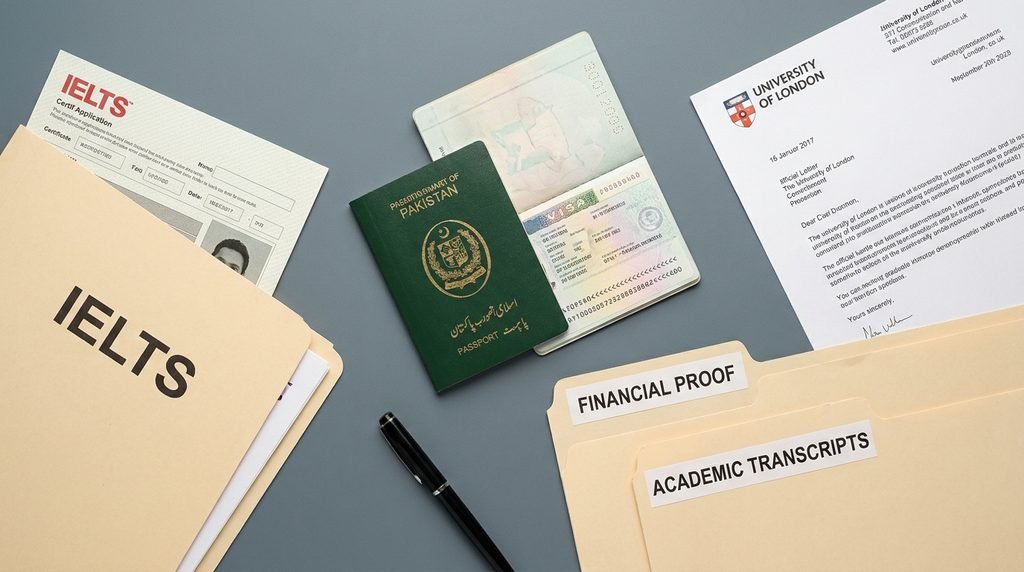
- Valid passport, signed (an unsigned Pakistani passport cannot have a visa printed in it — the embassy states this explicitly)
- CNIC
- Admission letter or enrolment confirmation
- Matric and Intermediate certificates, IBCC attested
- Bachelor’s degree and transcripts, HEC attested (Master’s applicants)
- Language certificate matching your programme’s language
- Blocking confirmation for the Sperrkonto
- Health insurance covering arrival until enrolment
- Motivation letter and CV
- Biometric photographs
- Proof of tuition payment where the programme charges tuition
No APS certificate. Nobody will ask you for one. If a consultant insists, ask them to show you the requirement on pakistan.diplo.de.
Real cost breakdown
| Item | Cost (EUR) | Cost (PKR @ 323) | Source |
|---|---|---|---|
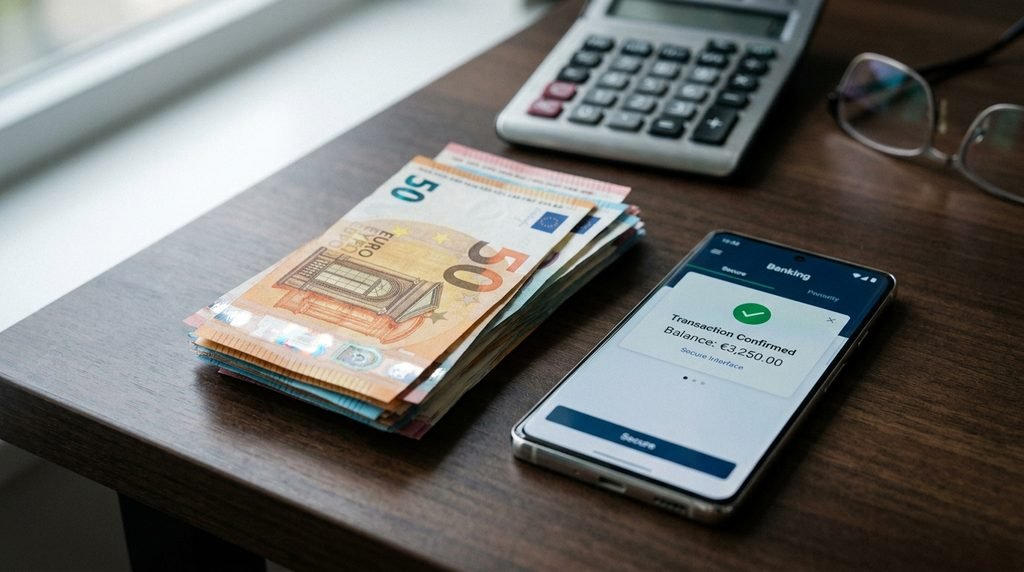
| Blocked account deposit | €11,904 | ~3,845,000 | Embassy Islamabad |
| National visa fee (Type D, adult) | €75 | ~24,200 | Federal Foreign Office |
| uni-assist, first course | €75 | ~24,200 | uni-assist fees |
| uni-assist, each extra course | €30 | ~9,700 | uni-assist |
| Embassy signature attestation | €25 | ~8,100 | Embassy Islamabad |
| HEC attestation, per document | — | 1,000–3,000 | [VERIFY on portal] |
| IBCC attestation, per certificate | — | ~1,200 reported | [VERIFY on portal] |
| Blocked account provider setup | — | — | [VERIFY: varies by provider] |
| APS certificate | €0 | PKR 0 | Does not exist for Pakistan |
That last row is the entire point of this article. Whatever an agent quoted you for APS — €185, PKR 58,000, PKR 30,000 — that money buys nothing.
Two details on the blocked account that catch people out. First, the €25 signature attestation must be done in person at the Embassy in Islamabad, the Consulate General in Karachi, or the Honorary Consul in Lahore, and you must bring exact cash. The embassy page says if you do not bring the exact amount, and the counter has no change, you book a new appointment and come back. Read that twice. Note also that the embassy page quotes €25 as “about 5400 PKR” — that line was written at an older exchange rate, and at September 2026 rates you should carry closer to PKR 8,100.
Second, and almost nobody mentions this: the Embassy and Consulate General reserve the right to request a blocked amount covering up to two years in particular cases. That is potentially €23,808. It is not the norm, but it exists in writing on the official page.
Realistic timeline
| Stage | Time needed | Start it when |
|---|---|---|
| anabin check | 1 day | Today |
| Language certificate (from zero to B1/B2) | 8–14 months | Immediately |
| IBCC + HEC attestation | 2–6 weeks | 12 months out |
| uni-assist processing | 4–8 weeks | Before the deadline, not on it |
| Admission decision | 4–12 weeks | — |
| Blocked account setup | 1–4 weeks | Day you get admission |
| Visa appointment + decision | Varies widely | Immediately after admission |
The embassy is open about the backlog. Its student visa page states the consular section is processing a high volume of applications and that demand exceeds capacity. It asks applicants to stop sending follow-up queries, because answering them reduces the capacity available to process files. Plan 10 to 14 months end to end, and treat any agent who promises a fixed visa date as a liar.
Mistakes and things worth knowing
Paying anyone for APS. Now you know. If you already paid, skip to the next section.
Assuming an agent is connected to uni-assist. uni-assist puts a banner on its own website stating it does not cooperate with commercial agencies in or outside Germany to place applicants at German universities. Any agency claiming an inside line is misrepresenting itself.
Starting German late. Pakistani students routinely assume strong English carries them. It does not. Studienkolleg is taught entirely in German, and B1 is the floor.
Only HEC scholarships count. The embassy’s financing page states that a scholarship awarded by a Pakistani university is not sufficient as proof of funds. Only an HEC award is accepted. If your plan rests on a university merit scholarship, your plan needs a blocked account too.
Sending money late. Large outward remittances from Pakistani banks get held for compliance checks. Open the account the day your admission letter lands, not the week of your appointment.
Insider note on work rights: once you are in Germany on a §16b student residence permit, you can work 140 full days or 280 half days per calendar year. That went up from 120/240 on 1 March 2024 under the Skilled Immigration Act. Minimum wage in 2026 is €13.90 an hour and rises to €14.60 on 1 January 2027. Older guides still quoting 120 days are out of date. Our Germany work visa and Opportunity Card breakdown covers what happens after you graduate.
If an agent already charged you for APS
You are not stupid, and you are not alone. Consultancies with real offices in Islamabad and Lahore are publishing this claim on their own websites right now.
Do this:
- Ask them in writing to show the APS requirement on pakistan.diplo.de. Save the reply.
- Screenshot every receipt, WhatsApp thread and portal login they gave you.
- Ask for a refund in writing, citing that no APS office exists in Pakistan.
- If they refuse, file a complaint with your local consumer court. Written proof that they charged for a non-existent government service is strong.
- Do not let them “convert” the fee into other services quietly. Get the refund on paper first.
FAQs
Do Pakistani students need an APS certificate for Germany in 2026?
No. APS offices operate only in China, Vietnam and India. Pakistan has never had one, and the German Embassy in Islamabad does not list APS among its student visa documents. Pakistani academic records are verified through uni-assist or directly by the university, supported by HEC and IBCC attestation.
What is the APS Germany fee in PKR for Pakistanis?
There is none, because there is no APS process for Pakistan. Figures circulating online such as €185 or PKR 58,000 originate from AI-generated blog content, not from any German government source. Any agent charging an APS fee in Pakistan is charging for a service that does not exist.
Is aps-southasia.de the official APS portal for Pakistan?
No such official portal exists. The genuine APS websites are aps-india.de for India and aps.org.cn for China. The aps-southasia.de address appears only on SEO blogs and consultancy pages, never on German government, DAAD, or German university websites.
How do I do APS tracking from Pakistan?
You cannot track an application that was never possible to file. If a portal shows you a tracking status for a Pakistani APS application, it is not operated by the German Embassy. Track your real application instead through your uni-assist My assist account and the Consular Services Portal.
Do I still need HEC attestation if there is no APS?
Yes. HEC attestation of your degree and transcripts remains part of a strong application file, and it is required before MOFA or embassy attestation. Since 11 May 2026, HEC runs a fully online paperless system issuing e-Attestation Certificates through eservices.hec.gov.pk.
Can I go straight from FSc to a German Bachelor’s degree?
Usually no. Pakistani Intermediate qualifications are not rated as equivalent to the German Abitur in the anabin database. Most students need a Studienkolleg year plus the Feststellungsprüfung, or one to two years of completed study at an H+ recognised Pakistani university first.
How much money do Pakistani students need in a blocked account for 2026?
€11,904 for twelve months, released at €992 per month after arrival. At September 2026 rates that is roughly PKR 3,845,000. The German Embassy Islamabad and Consulate General Karachi also reserve the right to require up to two years of funds in particular cases.