
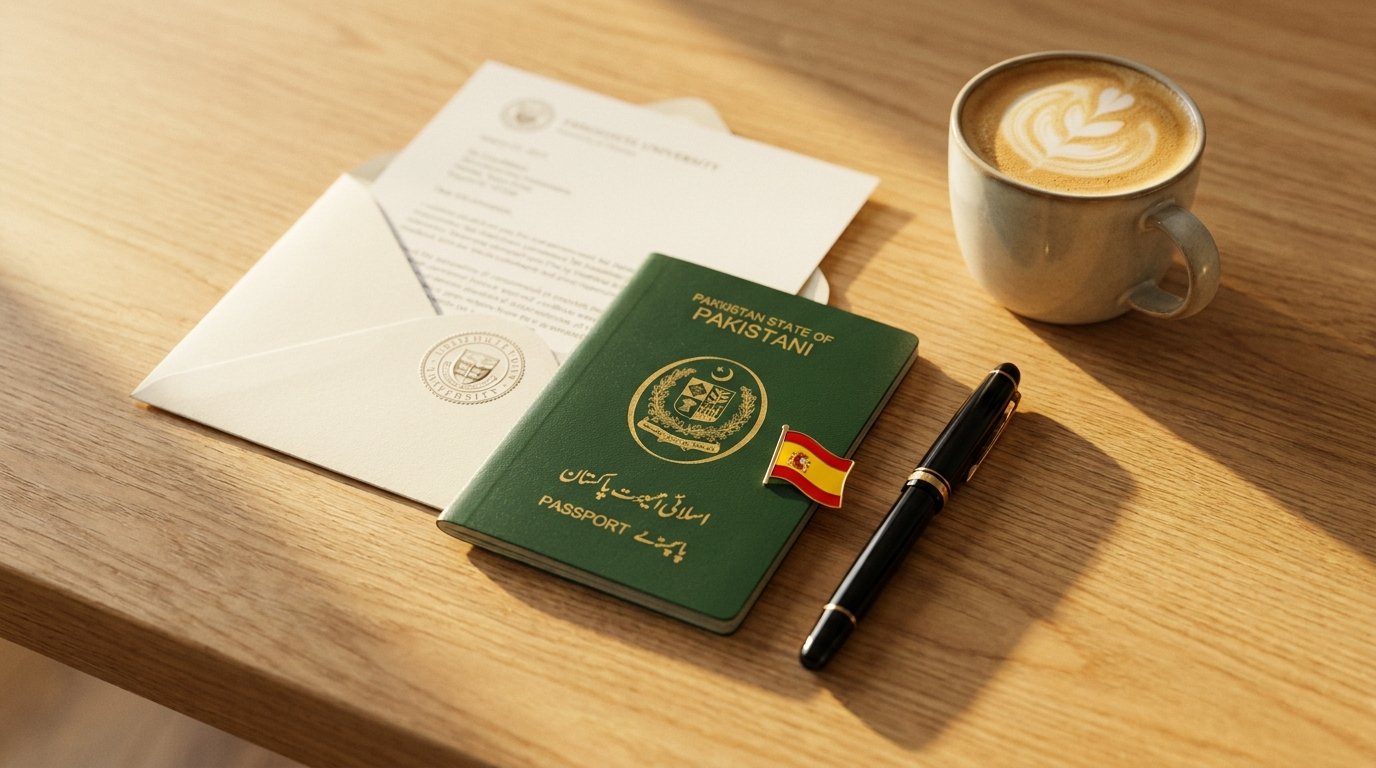
A friend of mine spent three days messaging a Facebook page called “BLS Spain Visa Pakistan” before she realized the account wasn’t even real anymore. The actual visa center had quietly rebranded months earlier, and half the Pakistani study-abroad groups online still haven’t caught up. That’s the real problem with researching spain study visa requirements right now — most of what’s floating around was accurate eighteen months ago, and nobody went back to fix it.
I’ve sat with enough friends going through this — Madrid, Barcelona, one guy grinding through a PhD application in Valencia — to know where people actually get stuck. It’s rarely the big stuff like admission. It’s the small print: which office attests what, how much money needs to sit in an account, and why your file goes quiet for six weeks with zero explanation.
Quick answer: For a spain study visa from Pakistan in 2026, you need a university admission letter, HEC/MOFA-attested academic documents, proof of roughly €600 a month (about €7,200 a year, close to PKR 2.3 million) in funds, health insurance, and accommodation proof. You apply in person through Intiana in Islamabad, Lahore, or Karachi, pay around €90, and wait roughly 4–8 weeks for a decision.
Type C or Type D — Get This Sorted First
If you searched “spain visa requirements pakistan” and landed here mildly confused, that’s normal, because Spain runs two completely different systems depending on how long you’re staying. If your program runs 90 days or less — a summer school, an intensive language course, a short exchange — you only need a Schengen visa (Type C), the same category we cover in our Schengen visa guide for Pakistanis. Anything longer, including almost every Bachelor’s, Master’s, PhD, or full academic-year language program, needs the national long-stay visa — the Visado Nacional de Estudios, or Type D. That’s what this guide is about. If you’re first visiting Spain to scope out a university, or visiting family before you commit, that’s a different application entirely, and we’ve broken it down in our Spain visit visa guide.
One distinction that trips people up constantly: a “student visa” and a “language-course visa” sound identical, but Spain treats them quite differently since the 2025 immigration reform, especially around work rights and renewals. More on that further down.
The Actual Step-by-Step Process
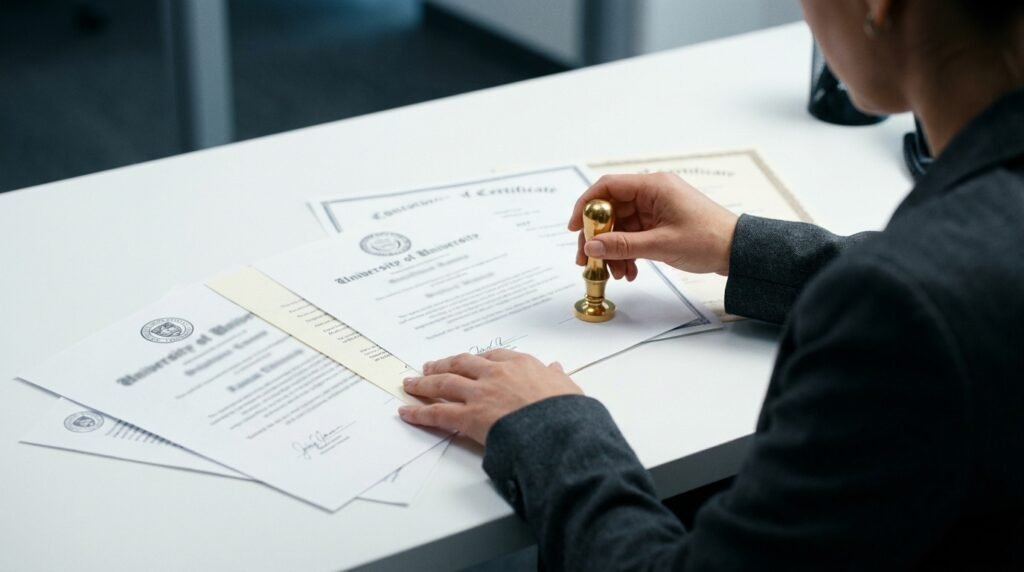
Here’s roughly how it goes, in the order that actually matters:
- Get admitted first. You need an official acceptance letter from a recognized Spanish institution before anything else moves. A conditional offer is usually enough to start your visa file, but confirm with your specific university.
- Start your document attestation immediately. Don’t wait for your final, unconditional offer letter. This step is the single biggest time-eater in the whole process, and starting it late is the number one reason people miss their intake.
- Sort your finances — bank statements, sponsor letters, whatever route you’re taking.
- Buy comprehensive health insurance valid for your full stay, with no co-payments.
- Arrange accommodation proof — a signed rental contract, university housing confirmation, or an invitation letter.
- Fill out the national visa application form and gather everything on the checklist below.
- Submit in person at the Spain Visa Application Centre in Islamabad, Lahore, or Karachi — currently run by Intiana, formerly branded as BLS International. Unlike the Schengen tourist visa, national visa applications here don’t require a pre-booked appointment; you can walk in. Confirm this hasn’t changed by checking thespainvisa.com before you go, since the center relocated its Islamabad office in July 2026 and small rules shift often.
- Give biometrics and pay the fee, in cash, in Pakistani Rupees.
- Track your file online and wait it out.
- Collect your passport once a decision lands, and check the visa sticker’s dates before booking flights.
- Travel to Spain, then handle NIE/TIE registration within 30 days of landing — covered further down.
Every Document You Actually Need
Most spain study visa requirements lists online are close, but missing one or two items that only show up once you’re actually at the counter. Here’s the fuller version:
- Completed and signed national visa application form
- Valid passport covering your full stay, with at least two blank pages, issued within the last 10 years, plus photocopies of every used page, including old passports
- Two recent passport photos
- University acceptance letter stating the program, dates, and full-time status
- Proof of tuition payment, or at minimum a deposit and payment plan
- Academic documents attested through the right chain: your degree through HEC if you’re a graduate, or your Intermediate/FSc certificate through IBCC if you’re applying straight from school, followed by MOFA apostille. Since Spain is part of the Hague Apostille Convention, that MOFA stamp is usually the final step. You do not need separate embassy legalization on top of it, which is something a few agents will happily charge you extra for anyway. If you’ve also looked into studying in Germany, you’ll recognize the general shape of this — it’s a lighter version of the dance covered in our APS certificate guide.
- Financial proof covering roughly €600 a month (more on this next)
- Comprehensive private health insurance with no co-pay, valid for your entire stay
- Proof of accommodation in Spain
- Police character certificate, apostilled
- A cover letter or statement of purpose explaining your program and your plans afterward
- Visa fee payment receipt
The Bank Statement Question Everyone Panics About

This is the part that stresses people out more than anything else, and it’s genuinely the most common reason for spain study visa bank statement rejections.
Spain calculates the minimum using something called the IPREM, a public income index, and for 2026 it’s holding at €600 a month, the same as 2025. In practice that means showing roughly €7,200 for a full academic year, on top of tuition. You can meet this with your own savings, a scholarship award letter, or a sponsor (usually a parent) backed by their bank statements, income proof, and a notarized letter confirming they’ll fund you.
Here’s a mistake I’ve watched happen more than once: a friend’s father deposited a lump sum into the account two weeks before the appointment, just to “top it up.” The consular officer flagged it immediately, because a sudden, unexplained deposit looks exactly like borrowed money, even when it isn’t. Build the balance up gradually, over months, not days, and keep six months of statements ready to show.
One thing that actually works in Pakistani applicants’ favor: you generally don’t need a restricted or “blocked” account the way some destinations require. A normal statement or a documented sponsorship letter is enough — one less headache than, say, Germany’s blocked-account system.
What It Actually Costs — In Euros and Rupees

| Item | Approximate Cost |
|---|---|
| Visa fee | ~€90 (roughly PKR 28,000–29,000) |
| Intiana service charge | Separate line item, paid in cash on top |
| HEC + MOFA attestation | A few thousand rupees, plus 1–3 weeks of your time |
| Health insurance (annual) | Roughly €100–€300, depending on provider |
| Financial proof required | ~€7,200/year (about PKR 2.3 million) |
| Public university tuition | €750–€2,500/year for a bachelor’s |
| Master’s tuition | €1,000–€4,000+/year |
| Living costs | €600–€900/month |
| Rent | €250–€600/month, depending on city |
The spain student visa fee pakistan applicants currently pay sits at roughly €90, though older blogs still quote €80 — the rate before an increase that took effect in mid-2024. Confirm the current number before finalizing your budget, since a lot of guides simply never get updated.
The number that actually stings is the financial proof requirement once you convert it. Doing that math myself the first time — watching €7,200 turn into well over two million rupees on screen — is a specific kind of stomach-drop. Budget for that moment early, and don’t leave your currency conversion until appointment week, since the rupee has moved around quite a bit against the euro this year.
How Long Spain Student Visa Processing Time Really Runs
By law, Spain has about 38 days to decide on a study visa application. In practice, spain student visa processing time for Pakistani applicants usually runs 4 to 8 weeks, and I’d budget closer to 10–12 weeks if you’re applying in the June-to-September rush, when every consulate handling Spain in the region is buried under intake-season volume.
One detail most guides skip entirely: if the deadline passes with no answer, Spanish administrative law treats that silence as a provisional refusal, not an approval. So if you hit the roughly 38-day mark with nothing in your inbox, it’s on you to follow up directly with the consular section, rather than assume no news is good news.
If the embassy requests extra documents, the clock resets from scratch. That single fact causes more delays than anything else on this list, so submit a complete file the first time instead of a fast, incomplete one.
Landing in Spain: NIE, TIE, and the Paperwork Nobody Warns You About

Getting the visa sticker isn’t the finish line. Within roughly 30 days of entering Spain, non-EU students have two more steps to close out.
First, empadronamiento — registering your address at the local town hall. You’ll need this certificate for almost everything that comes after, so don’t put it off.
Second, the TIE (Tarjeta de Identidad de Extranjero), your physical residence card. Book a fingerprint appointment at the local police station or Oficina de Extranjería, bring your passport, visa, empadronamiento certificate, and a photo, then wait for the card to be ready. Your NIE, the foreigner ID number, is already assigned through your visa, so you’re not applying for that piece separately — just the physical card itself.
Since May 2025, this whole stretch got a little less repetitive. Instead of renewing your permit every single year, higher-education students now get one authorization covering the entire program. A three-year degree means you’re not doing this dance three separate times.
Can You Actually Work? What Changed in 2025
Since Spain’s immigration reform (Royal Decree 1155/2024) took effect in May 2025, students enrolled in an actual degree program — bachelor’s, master’s, PhD, or official vocational training — can work up to 30 hours a week, automatically, tied to the visa itself. No separate work permit, no geographic restriction, and the employer doesn’t need to file anything extra on your behalf.
If you’re only in Spain for a language course, don’t assume the same rules cover you. Language-only students face tighter limits: converting to a work-based residence is harder, renewals are capped, and you may need a language exam like DELE or SIELE to extend your stay at all. A lot of blog posts flatten this distinction completely, which is exactly how people end up planning their finances around rights they don’t actually have.
After finishing your studies, you get 12 months to stay in Spain and look for work, or start freelancing, with no need to extend or reapply for anything — and without the old rule that used to require holding student status for three years first.
Mistakes That Cost People Months
- Trusting outdated visa-center names. The center handling Spain visas in Pakistan has rebranded before, and even the official Spanish government embassy page in Islamabad still references the old name in places. Go by whatever the current portal says, not by whatever name shows up first on Google.
- Buying the wrong insurance. Ordinary travel insurance bought in Pakistan almost never meets Spain’s no-copay requirement. Check the fine print before you buy, not after you’re rejected.
- Mixing up HEC and IBCC. A bachelor’s degree goes through HEC. An Intermediate or FSc certificate goes through IBCC. Sending the wrong document to the wrong office wastes real weeks.
- Assuming a tourist visa can convert to a study visa from inside Spain. Since May 2025, this generally has to be handled from Pakistan instead, with only narrow exceptions.
- Ignoring homologación. Some bachelor’s programs at public universities require formal recognition of your prior qualification before enrollment is final — a process the Spanish education ministry oversees, and one that can take months. Ask your university directly, early, instead of assuming your admission letter settles it.
- Missing the 30-day TIE deadline after landing.
The Moves That Actually Help
- Start the HEC/MOFA chain the day you get even a conditional offer, not after the final one arrives.
- Since national visa submissions in Pakistan are typically walk-in, arrive early morning to skip the queue — but confirm this is still current policy right before you travel, since it has changed before. Details like this sit on the Spanish embassy in Islamabad’s own page, too.
- Keep your bank balance stable for at least six months before applying. No large, sudden top-ups, ever.
- If your program is a language course rather than a degree, ask your school in writing what your renewal and work rights actually look like under current rules.
- Once you’re settled, if your parents want to fly out for graduation, they’ll need their own Schengen visit visa. PaceDraft’s free Schengen cover letter tool can handle that drafting headache for them.
What is the Spain student visa fee for Pakistani applicants?
Around €90, paid in PKR cash at the visa center, plus a separate service charge. Some older sources still list €80, which was the rate before a mid-2024 increase.
How much money do I need for a Spain study visa bank statement?
Roughly €600 a month, or about €7,200 for a full year, based on the 2026 IPREM. This can come from personal savings or a documented sponsor.
How long does Spain student visa processing take from Pakistan?
Officially around 38 days; realistically 4–8 weeks, stretching to 10–12 weeks during peak intake season or if the embassy requests more documents.
Can I work while studying in Spain on a student visa?
Yes, up to 30 hours a week, automatically, if you’re enrolled in an actual degree program. Language-course students face different, more limited rules.
Do I need HEC attestation for a Spain study visa?
Yes, if you hold a bachelor’s degree or higher. If you’re applying straight from Intermediate/FSc, it goes through IBCC instead, then MOFA apostille.
Is BLS still handling Spain visas in Pakistan?
Not under that name anymore. The center has rebranded, though a few official pages and plenty of blog posts haven’t caught up yet.
The spain study visa requirements themselves aren’t the hardest part of this whole journey — it’s the small print that generic guides skip over. Get your attestation moving early, keep your bank statements clean, and double-check the current visa center portal before trusting anything you read online — including this. For more Pakistan-specific breakdowns, our full guide library covers everything from Germany’s attestation maze to the Schengen zone at large.



This is a pretty thorough guide. Are the visa requirements expected to change much in the next few years?
Yes its posible
yes its possible