
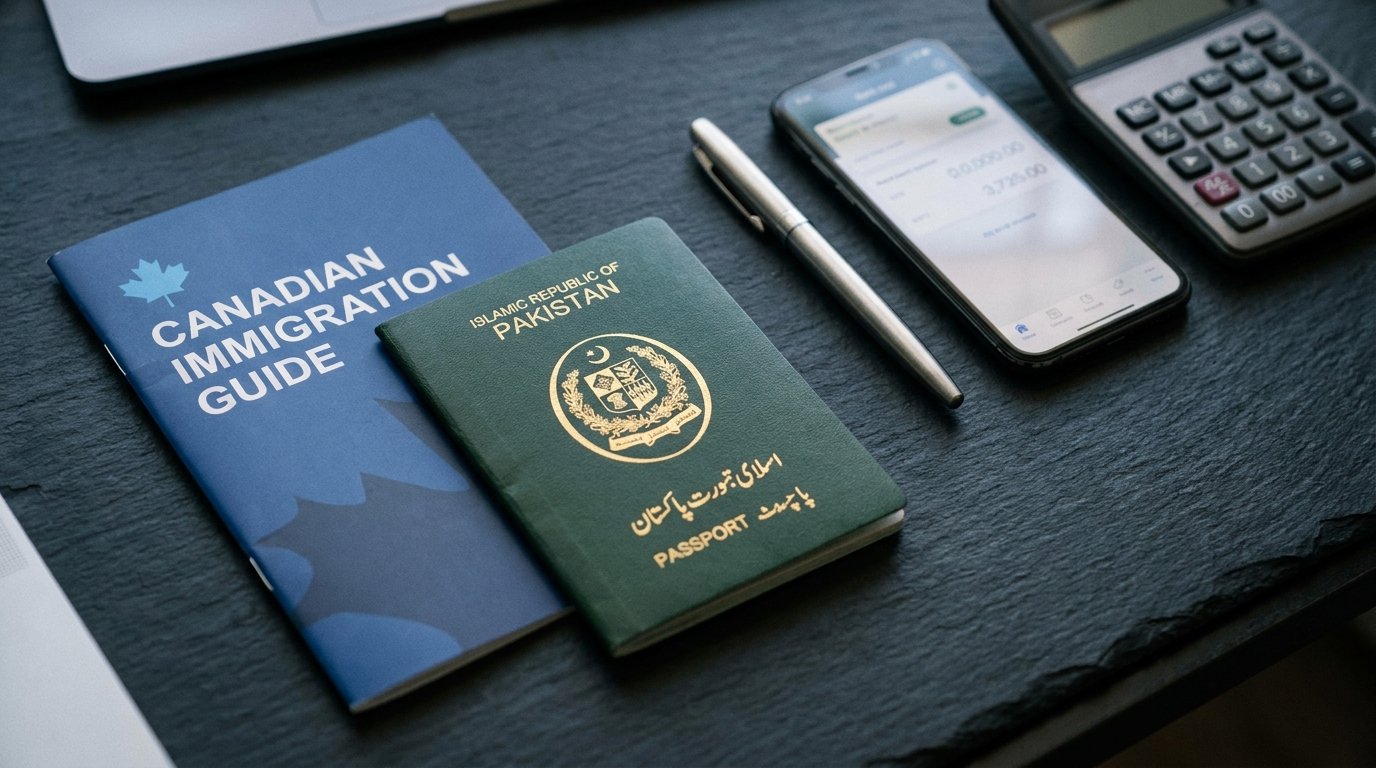
A guy from my old university WhatsApp group got a job offer last winter — logistics coordinator, somewhere outside Toronto. He’d read one blog, saw “$155 CAD,” and figured that was the whole bill. Three weeks later he was messaging half the group asking who had spare dollars lying around, because nobody had mentioned biometrics, the VAC charges in Islamabad, or that his HEC attestation alone would eat into what he’d already saved. He got his permit in the end. But he spent more time scrambling for rupees than actually preparing his file, and that’s the part almost every guide conveniently skips.
If you’ve been searching around for the real pakistan to canada work visa price, you’ve probably noticed the same thing I did — half the results are American blogs with “Canada” awkwardly swapped in, and the other half quote a single number and stop there. This is the version I wish someone had sent my friend before he started. Every figure below comes from IRCC’s own fee page, the VFS Global site for Pakistan, and Employment and Social Development Canada’s current rules — not a forum post from three years ago.
Quick answer: The exact work permit canada fee is CAD $155 (about PKR 31,000) as the base IRCC charge. Add $100 if it’s an open work permit, $85 for biometrics, and roughly PKR 10,000–20,000 more in VAC service and courier charges. Employers pay a separate $1,000 CAD LMIA fee — not you. Most Pakistani applicants spend somewhere between PKR 45,000 and 100,000 total, before any medical exam.
Open Work Permit or Closed? This Decides Your Whole Fee Structure

Before you can even work out your Canada work permit fee, you need to know which kind you’re getting, because IRCC charges differently for each one.
An open work permit lets you work for almost any employer in Canada — no single job offer required. Post-Graduation Work Permits, spousal open work permits, and bridging open work permits all fall here. Apply for one of these and you pay the $155 base fee and the $100 “open work permit holder” fee. That’s $255 CAD before biometrics even enters the picture.
A closed work permit — IRCC’s own paperwork calls it “employer-specific” — ties you to one employer, one job, sometimes one location. This is what most Pakistani skilled workers and TFWP applicants end up with. The canada closed work permit cost is simpler on paper: just the $155 base fee, no extra holder fee. The catch is that your employer usually needs a positive Labour Market Impact Assessment (LMIA) first, and that runs on its own timeline, completely outside your control.
The Real Canada Work Permit Fee Breakdown (2026)
The IRCC work permit fee for Pakistan-based applicants is identical to what anyone else in the world pays — Canada doesn’t charge by nationality. What changes is everything layered on top of it once you’re actually applying from Islamabad, Karachi, or Lahore rather than, say, Manila or Lagos.
| Cost | Who Pays | Amount (CAD) | Approx. PKR* |
|---|---|---|---|
| Work permit processing fee | You | $155 | ~₨31,000 |
| Open work permit holder fee (open permits only) | You | $100 | ~₨20,000 |
| Biometrics, per person | You | $85 (₨170 family max) | ~₨17,000 (~₨34,000/family) |
| LMIA processing fee | Employer | $1,000 | ~₨202,000 |
| VAC photo (ICAO-compliant) | You | — | ₨1,095 |
| VAC SMS status updates | You | — | ₨615 |
| VAC one-way courier | You | — | ₨8,497 |
| Immigration medical exam (only if required) | You | $200–$500 | ~₨40,000–₨100,000 |
| Police certificate (PCC) | You | — | ₨350–₨2,000 |
| HEC degree attestation (if your case needs it) | You | — | ₨3,000/document |
*PKR approximate at roughly ₨202 per CAD, July 2026. This moves daily — check the live rate before you budget down to the last rupee.
A few things most cost breakdowns get wrong. First, your $85 biometrics fee already includes one “package transmission” — the VAC moving your passport to IRCC and back — so you’re not automatically paying extra for that unless you submit documents at a different VAC than the one where you gave biometrics. Second, those VAC line items (photo, SMS, courier) are individually optional. Skip the photo service if you bring your own compliant ones, skip courier if you’re fine collecting your passport in person. Third — and this genuinely caught the friend I mentioned off guard — some banks won’t let you pay an IRCC fee straight off a PKR-denominated card without their own conversion markup stacked on top of the posted rate. Budget an extra couple thousand rupees just for that friction.
On the LMIA fee: your employer pays that $1,000 CAD to ESDC directly, not you, and it’s actually against program rules for them to pass that cost onto you or quietly deduct it from your first salary. If an employer or a “consultant” asks you to cover it, that’s worth walking away from.
How the Process Actually Works From Pakistan

- Get the job offer in writing, with either an LMIA confirmation number or documented proof the role is LMIA-exempt (intra-company transfer, Global Talent Stream, an eligible International Mobility Program category, and so on).
- Wait on the employer’s LMIA, if one’s needed. This runs on ESDC’s clock, entirely separate from your own IRCC application — and it’s the step most Pakistani applicants underestimate.
- Apply online through the IRCC portal. Paper applications still technically exist, but online moves faster, and there’s no real argument for mailing anything in 2026.
- Pay your fees — $155, plus $100 if it’s an open permit, plus biometrics.
- Wait for your Biometric Instruction Letter (BIL). Since March 2026, VFS Pakistan changed how appointments get booked — you now upload the BIL itself before you can even schedule, so don’t try booking without it in hand.
- Attend your VAC appointment in Islamabad, Karachi, or Lahore. Lahore’s centre relocated in late June 2026, so confirm the current address before you head out.
- Track your application online and answer anything IRCC asks for quickly — the faster processing times in 2026 mean officers have less patience for slow replies.
- Submit your passport through the VAC once your passport request letter arrives.
- Collect your passport and decision.
Canada Work Permit Requirements 2026: What Goes in Your File
- Valid passport, with enough validity left to cover the permit plus a buffer
- Job offer letter and LMIA confirmation number, or your LMIA-exemption code
- CNIC, and family registration documents where relevant
- HEC-attested degree and transcripts, if your occupation or a regulated profession requires credential verification
- Police Character Certificate, MOFA-attested, covering every country you’ve lived in for six months or more since turning 18
- Immigration medical exam results, only if your specific occupation or situation actually calls for one
- Passport photos meeting ICAO specifications
- A clear, specific letter explaining your situation — a generic, template-sounding paragraph doesn’t do you any favors, and this is exactly where a properly built cover letter earns its place; PaceDraft’s document tools can put one together in a few minutes instead of a few days
- A No Objection Certificate, if your current Pakistani employer needs to formally release you — again, something PaceDraft’s NOC generator handles quickly
The Timeline Nobody Gives You Straight
IRCC’s own weekly-updated tracker showed Pakistan-based work permit applications sitting anywhere from 16 to nearly 30 weeks earlier in 2026. By the most recent update this summer, that figure had dropped to roughly 5 weeks — a genuinely large improvement. But it’s also a snapshot that shifts week to week, covers only the fastest 80% of cases, and measures IRCC’s side of the process only.
If your permit depends on an LMIA, that clock runs separately, and right now it’s the slower half of the equation. As of mid-2026, Global Talent Stream LMIAs — the fast lane for software engineers and specialized tech roles — are processing in around 8 to 10 business days. The high-wage stream sits closer to 64 business days. The low-wage stream is slower still, and since April 2026 it isn’t being processed at all in roughly 30 major Canadian cities where unemployment sits at 6% or higher.
Put together honestly: if your role is LMIA-exempt, 2 to 4 months from application to decision is realistic in 2026. If your employer needs a standard LMIA, budget 4 to 8 months from job offer to landing — and don’t resign from your current job or book a flight until you’re actually holding an approved permit. Sabr karo. Patience here isn’t a nice-to-have; it’s the only thing standing between you and a very expensive mistake.
Mistakes That Cost People Real Money (and Real Time)

Assuming $155 covers everything. You’ve read this far, so you already know better than my friend did.
Skipping MOFA attestation on the police certificate. A PCC straight from your local Police Khidmat Markaz or district office isn’t, by itself, something a Canadian visa office will accept — it needs Ministry of Foreign Affairs attestation first. People usually find this out only after their file gets flagged incomplete, which costs weeks they didn’t need to lose.
Confusing Express Entry’s “proof of funds” with work permit requirements. If you eventually apply for permanent residence through the Federal Skilled Worker Program, you’ll need a specific, published settlement-funds amount sitting in your account. For a straightforward work permit application backed by a genuine job offer, that fixed table doesn’t apply — though an officer can still ask general questions about your finances, so don’t show up with an empty account either.
Letting a job offer or LMIA go stale while you gather documents. HEC attestation, PCC issuance, and medical exams all eat real weeks. Start them the moment you have a written offer, not after the LMIA clears — they run in parallel, and there’s no reason to let paperwork become your bottleneck.
Not checking whether the role even qualifies in 2026’s tighter market. Low-wage LMIA rules tightened hard this year: longer advertising requirements, mandatory youth-recruitment efforts, and regional freezes in high-unemployment cities. A job that would have sailed through in 2023 might now sit in a queue for months, or get refused outright. Ask the employer directly which stream they’re filing under before you get your hopes up.
What Changed in 2026 (and Why It Matters)
HEC attestation went fully digital on May 11, 2026 — no more couriering original documents or standing in line at the Islamabad office. It’s a paperless, blockchain-verified system now, and the fee sits at Rs. 3,000 per document. If your degree was already stamped under the old system, it’s still valid; you don’t need to redo it.
On the Canadian side, the low-wage LMIA stream picked up an eight-week advertising requirement (double the old four), a youth-recruitment condition, and a processing freeze across roughly 30 high-unemployment cities. The wage threshold separating “low-wage” from “high-wage” streams itself updated on July 17, 2026 — worth a fresh check if your offer sits close to that line, since it changes both your work permit’s maximum length and which rules apply. Quebec extended its own freeze on low-wage applications in Montreal and Laval through the end of 2026. None of this touched the actual work permit canada fee structure — the $155 and $100 figures haven’t moved. What’s shifted is how hard it’s become for some employers, particularly in lower-wage roles, to get a positive LMIA in the first place.
FAQS
Is the work permit canada fee different for open and closed permits?
Yes. Open work permits cost $255 CAD total ($155 plus the $100 holder fee) before biometrics. Employer-specific, or closed, permits are just $155 — but they usually require your employer’s LMIA first.
Do I personally pay the LMIA fee?
No. The $1,000 CAD LMIA fee belongs to the employer, paid directly to ESDC. It’s against program rules for them to shift that cost onto you.
What’s the realistic total cost, all-in, for a canada work visa price in pakistan?
For most applicants: PKR 45,000–100,000 in direct costs — IRCC fees, biometrics, VAC charges, PCC, and attestation — before any medical exam. The employer’s LMIA cost sits outside that entirely and was never yours to pay.
Do I need proof of funds for a Canada work permit from Pakistan?
Generally, no — not in the fixed way Express Entry requires it. A genuine job offer covers most of that concern for a standard work permit. Keep your bank statements presentable regardless, since an officer can still ask.
How long does this really take from Pakistan in 2026?
IRCC’s own portion has dropped to roughly 5 weeks recently, down sharply from earlier in the year — but that figure moves weekly and excludes LMIA time entirely. Realistically: 2–4 months if you’re LMIA-exempt, 4–8 months if you’re not.
Do I need to hire a consultant for this?
Not for a clean, well-documented case — the process is genuinely built to be done yourself through the IRCC portal. A regulated Canadian immigration consultant earns their fee when your case has a complication: a past refusal, an unusual employment gap, or a role that’s borderline under 2026’s tighter LMIA rules.
Can a work permit lead to Canadian PR later?
Often, yes. Canadian work experience is exactly what the Canadian Experience Class under Express Entry looks for, and CEC applicants skip the settlement-funds requirement entirely. That’s a big enough topic for its own guide.
If you’re weighing this against other routes, we’ve broken down the UK’s version of this same process in similarly blunt detail — a lot of Pakistani applicants end up comparing the two side by side before committing. And if your file still needs a No Objection Certificate or a cover letter that doesn’t read like everyone else’s, PaceDraft’s document tools handle both in a few minutes.
Fees, processing times, and PKR conversions above reflect IRCC (canada.ca fee schedule), ESDC, and VFS Global’s published information as of July 2026. All three change without much notice — confirm current figures on IRCC’s processing time tool and VFS Canada’s Pakistan site before you pay anything.



Mujhe job de
what?